



The 2026 call for the 2209-A Research Projects Support Programme for Undergraduate Students is now open for applications. Applications must be submitted through the TÜBİTAK Management Information System (tybs.tubitak.gov.tr) until 17:30 on 11 November 2026.
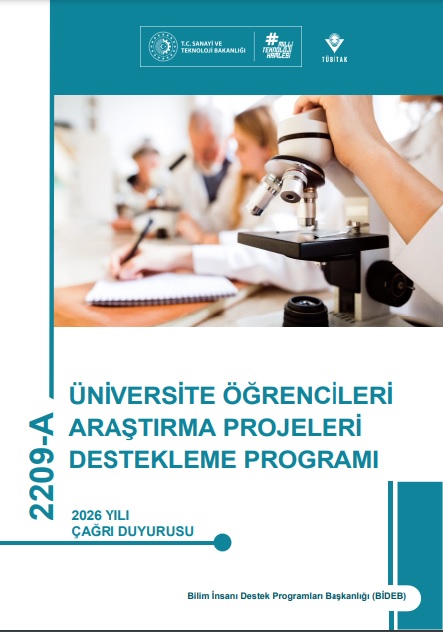
Click on the image below to access the 2026 call announcement for the 2209-A Programme.
Support is provided for machinery/equipment, consumables, travel and service procurement expenses required for research projects prepared by associate and bachelor’s degree students, individually or in teams. Congress/conference participation expenses, publication and patent expenses, accommodation expenses and per diem expenses (food and beverages) may not be included in the 2209 project support budget.
Research projects are supported for a maximum of 12 months. Support recipients must complete their projects within a maximum of one year following the announcement of the funding decision on the TÜBİTAK website.
The maximum support amount is TRY 12,000.
The IBAN entered in the online application must belong to the student serving as the project leader.
No travel allowances or per diem payments are made to students or advisors.
Accommodation expenses are not eligible for support.
Application Requirements
Applicants must be enrolled in a bachelor’s or associate degree programme in Türkiye.*
Registration in the Researcher Information System (ARBİS) is mandatory. All information must be completed in full and kept up to date. Individuals who do not have an ARBİS user account and password may obtain a password by completing the registration details at arbis.tubitak.gov.tr.
The project must be conducted under the supervision of an academic advisor.**
Applicants must not participate as a project leader or project partner in more than one application in the same call period and/or in a 2209-A or 2209-B project from a previous call period for which support is ongoing.
The same project must not have previously received support from TÜBİTAK.
Students may apply individually or as a team. A project may include a maximum of four project partners in addition to the project leader. In all applications, the project leader and the academic advisor are jointly and severally liable to TÜBİTAK.
An academic advisor may serve on a maximum of five (5) projects under the 2209-A Research Projects Support Programme for Undergraduate Students within the same call period.
No institution, organisation, company, commercial product or brand may be given prominence in any document submitted as part of the application, including the project title and project proposal. Furthermore, no discriminatory, exclusionary or offensive expressions may be used on grounds such as language, religion, race, sect, nationality, colour, gender, political opinion, philosophical belief, national or social origin, birth or economic status.
* Students enrolled in open education programmes or preparatory classes may not participate as project leaders or project partners.
** Academic advisors must have an up-to-date record in the Council of Higher Education (YÖK) system.
Call Period | Stage | Opening Date | Closing Date |
2026 | Application & Academic Advisor Approval | 07/10/2026 | 11/11/2026 |
| Institutional Authority e-signature | 16/11/2026 | 23/11/2026 |
The Research Proposal Form is generated automatically by the TÜBİTAK Management Information System (TYBS) based on the information entered into the system. Therefore, the application screens do not include a separate step for uploading a research proposal.
All project content sections in the online application system must be completed in full, taking into account the requirements set out in the “2209-A Research Projects Support Programme for Undergraduate Students – Application Content Information Note”. The information provided must be sufficient to enable a scientific evaluation of the project.
Applications must be submitted online by the project leader through the TÜBİTAK Management Information System (TYBS). The project leader must check that files uploaded to the electronic application system can be opened and that their contents are correct. The system closes for applications at the end of the working day (17:30) on the application deadline. Documents sent to BİDEB by email, post or fax outside the online application process will not be evaluated and will be destroyed.
Applicants must undertake that the information entered into the system is accurate and that they will comply with the programme obligations. Educational information is retrieved through online systems.
Academic advisor information is retrieved through online systems during the application process. The advisor’s information is checked first through the Higher Education Information System (YÖKSİS) and then through TÜBİTAK’s Researcher Information System (ARBİS). Academic advisors must therefore keep their information up to date in both systems.
After the project leader gives final approval to the application in the system, the project application details and attachments are sent in read-only format to the academic advisor’s registered email address for “advisor approval”. At this stage, the academic advisor undertakes that the information entered by the project leader is accurate, that they accept the advisory role, that the scientific and technological field under which the project will be evaluated is correct, that the department’s facilities are adequate and that the programme obligations will be fulfilled.
If the academic advisor returns the project to the student instead of approving it through TYBS, the student must make the necessary revisions and resubmit the project for the academic advisor’s approval.
If the academic advisor approves the project within the specified period, the application details are forwarded for signature to the institutional authorised signatory of the university in which the student project leader is enrolled. The application is considered valid after the institutional authorised signatory signs it through https://e-imza.tubitak.gov.tr.
The project leader and the academic advisor are responsible for following up on these processes.
An application may be withdrawn through TYBS within one (1) month of the call closing date.
Applications are evaluated in two stages.
Preliminary Review
• Application information and research proposals are checked during the preliminary review. Applications that fail to meet any eligibility requirement, are not prepared in the required format, contain information entered into the system that has not been approved by the application deadline, or are submitted by fax or email are rejected at the preliminary review stage without proceeding to scientific evaluation.
• Applications are rejected at the preliminary review stage if the research proposal is not prepared in the format specified by TÜBİTAK, does not meet the minimum character requirements specified in the template or is not prepared in Turkish.
Scientific Evaluation
- Applications that pass the preliminary review are evaluated by advisory board members or panelists/external reviewers with expertise in the relevant field, based on the following criteria:
- Scientific merit of the research proposal: 35%
- Methodology: 25%
- Project management: 20%
- Broader impact of the research proposal: 20%
- Evaluation is based solely on the documents uploaded to the system. Accordingly, documentation relating to each requirement must be uploaded through the application forms, with clear content that meets the specified requirements.
- A different minimum score for funding may be set for applications addressing the critical technology areas and priority R&D and innovation topics identified in the 12th Development Plan and the 2030 Industry and Technology Strategy.
- A balanced distribution across universities and scientific disciplines may be taken into account when selecting projects for support.
- Projects focusing on technological solutions aimed at achieving environmentally friendly, sustainable and climate-neutral societies may be financed under the “Supporting the Inclusion of Migrants in Türkiye’s Transition to a Green Economy Project”, implemented jointly by TÜBİTAK and UNIDO, if the project leader is a woman or an international student.
- Results are announced through the BİDEB Application and Monitoring System at https://e-bideb.tubitak.gov.tr.
Commencement of Support
If it is determined during scientific evaluation that the study requires ethics committee approval, an Ethics Committee Approval Document or an Ethics Committee Exemption Document must be uploaded to the BİDEB Application and Monitoring System (e-bideb.tubitak.gov.tr) within the period notified by email. Otherwise, the project cannot be put into effect.
Projects that score above the minimum funding threshold during scientific evaluation receive a funding decision. These projects are put into effect and the project support is transferred to the project leader’s bank account after checks for alignment with national science and technology strategies, compliance with ethical principles and similarity have been completed, together with the submission of ethics committee approval or exemption documents where required.
Monitoring and Project Completion
Project expenditures must be documented with invoices. If fixed assets are purchased, they must be registered in the university’s inventory after the project is completed, and an inventory registration document must be obtained. Invoices must be issued in the name of the project leader or a project partner. Receipts that do not bear a name, except fuel receipts, are treated as ineligible expenditure, and repayment is requested. Undocumented or unused support must be returned to the TÜBİTAK bank account specified on the programme website. The project leader and the academic advisor are jointly and severally liable for ensuring that expenditures comply with the relevant legislation.
If a change of academic advisor is requested after the project has been put into effect, the request must be submitted through the BİDEB Application and Monitoring System, together with written approvals from the current and proposed academic advisors confirming their agreement to the change.
If a change of project partners is requested after the project has been put into effect, the request must be submitted through the BİDEB Application and Monitoring System, together with written approvals from the student wishing to leave the project team and the student joining the team, confirming their agreement to the change. The number of project partners may not be changed after the project has been put into effect.
Requests to change project partners and/or the academic advisor are not accepted when less than three months remain until the project end date.
Outputs arising from research conducted under the programme, such as articles, conference papers, books and book chapters, must be reported to TÜBİTAK. Information on these outputs must be uploaded to the BİDEB Application and Monitoring System. All announcements, publications and scientific events under the programme must acknowledge TÜBİTAK support and display the TÜBİTAK logo, except where the applicable rules do not permit the logo to be used, such as in certain theses or articles. The logo must be used in accordance with the specifications and standards published on the TÜBİTAK website. No statement may be made that creates the impression of acting on behalf of TÜBİTAK and/or conducting the work in collaboration with TÜBİTAK.
The final report, covering all scientific and technical developments in the project, and the expenditure table available in the BİDEB Application and Monitoring System must be submitted within the project period as follows:
The project leader uploads them to the BİDEB Application and Monitoring System in the format specified by TÜBİTAK.
The academic advisor checks them and gives final approval.
If an item classified as a fixed asset has been purchased, the inventory registration document obtained from the university and checked by the academic advisor must be presented upon TÜBİTAK’s request.
Invoices entered in the expenditure information screen and checked by the academic advisor must be presented upon TÜBİTAK’s request.
There is no requirement to send the final reports uploaded to the BİDEB Application and Monitoring System, or the final report form generated by the system, to BİDEB by post or email.
Final reports are evaluated collectively by reviewers appointed by BİDEB after the final report submission deadline for the relevant call period. If a report is not found satisfactory by the reviewer, revisions must be made within the specified period.
If the final report is not uploaded to the BİDEB Application and Monitoring System by the end of the support period, any extension granted by GYK applies to all projects supported in the relevant call period.
Projects for which final reports are not submitted to BİDEB within the project period, or for which revised reports are not accepted, will be discontinued or cancelled, depending on the determination of fault. The project leader and the academic advisor are responsible for ensuring that the final report is uploaded to the BİDEB Application and Monitoring System within the project period.
Obligations
- The project leader and the academic advisor are jointly and severally liable for fulfilling the obligations applicable to the application, monitoring and project completion processes.
- The project leader, any project partners and the academic advisor must comply with the provisions of the TÜBİTAK Research and Publication Ethics Board (AYEK) Regulation and other universally accepted ethical rules throughout the research. In the event of non-compliance, action may be taken against the persons concerned under the AYEK Regulation.
- TÜBİTAK BİDEB issues notifications electronically. Therefore, the contact information registered in the ARBİS account at the time of application must be suitable for receiving official notifications and must be kept up to date at all times.
- During the preparation and submission of the project proposal and all project-specific information, and thereafter, the project leader must fully comply with all principles, rules and obligations set out in the “Guidelines for the Responsible and Trustworthy Use of Generative Artificial Intelligence (GenAI) in TÜBİTAK Funding Processes” concerning the use of generative artificial intelligence tools. The project leader assumes responsibility for ensuring that all information provided or to be provided about the use of GenAI is complete and truthful.
- The academic advisor must verify the accuracy, originality, currency and scientific reliability of all text, visuals, analyses, recommendations and similar content generated using GenAI tools and included in the project texts and attachments, make the necessary corrections and revisions, and assume ultimate responsibility for such content. The academic advisor must also comply with all rules, principles and obligations set out in the “Guidelines for the Responsible and Trustworthy Use of Generative Artificial Intelligence (GenAI) in TÜBİTAK Funding Processes”.
The program is subject to the regulations listed below:
- Türkiye Bilimsel ve Teknolojik Araştırma Kurumu Bilim İnsanı Destek Programları Başkanlığı Burs ve Destek Programlarının Yürütülmesine İlişkin Usul ve Esaslar
- Türkiye Bilimsel ve Teknolojik Araştırma Kurumu Bilim İnsanı Destek Programları Başkanlığı Tarafından Yürütülen Programlara İlişkin Yönetmelik
- BİDEB Burs ve Destek Programlarında Başvuruların ve Raporların Panel/Danışman/Danışma Kurulu Yöntemi ile Değerlendirilmesi ve İzlenmesine İlişkin Yönerge
GYK decisions apply to exceptional circumstances not addressed in the relevant legislation or the call announcement.
TÜBİTAK BANK ACCOUNT INFORMATION (TL)
Account Name: TÜBİTAK STRATEJİ GELİŞTİRME DAİRE BAŞKANLIĞI
Name of Bank and Branch: VAKIFBANK ATATÜRK BULVARI ŞUBESİ
IBAN No: TR49 0001 5001 5800 7290 1092 35
TÜBİTAK-BİDEB 2209/A
Research Support Programme for Undergraduate Students
TÜBİTAK Bilim İnsanı Destek Programları Başkanlığı
Adress: TÜBİTAK Başkanlık Binası
Tunus Caddesi No:80 Kavaklıdere
ÇANKAYA/ANKARA PK:06100
Tel: 444 66 90
e-mail: bideb2209a@tubitak.gov.tr