
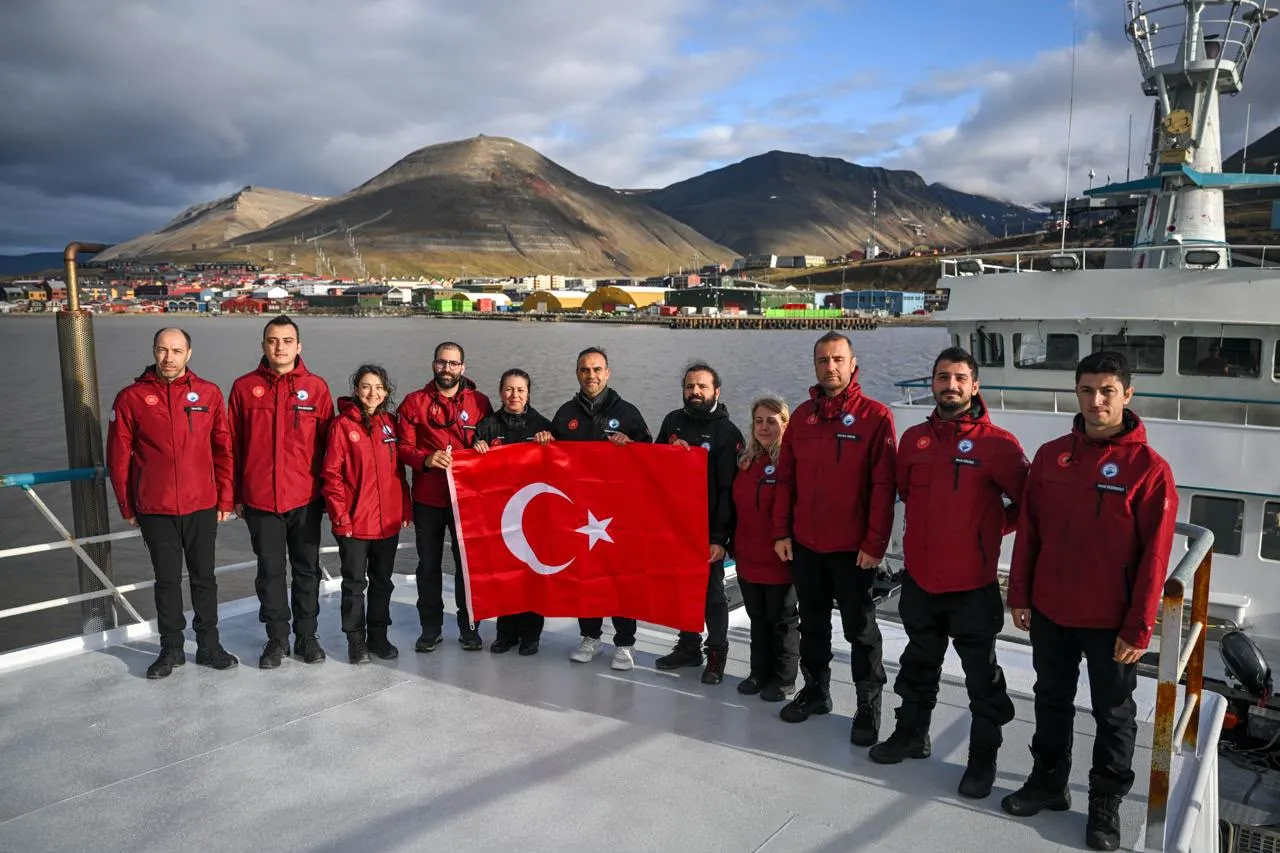
Conducted under the auspices of the Presidency of the Republic of Türkiye, under the authority of the Ministry of Industry and Technology, and coordinated by TÜBİTAK Polar Research Institute (KARE), the 6th National Arctic Scientific Research Expedition (TASE-VI) has been successfully completed. The expedition marked several historic milestones, strengthened international scientific collaboration, and served as a platform for critical research expected to advance global understanding of climate change.
The Turkish scientific delegation has successfully completed its demanding polar mission in the Arctic Ocean. During the 22-day expedition, which covered more than 4,000 nautical miles around the Arctic Ocean, physical and biological measurements were carried out at over 90 stations, while 12 distinct scientific research projects were successfully implemented.
Beyond its scientific achievements in the field, the 6th National Arctic Scientific Research Expedition also marked a historic first through high-level official participation. Minister of Industry and Technology Mehmet Fatih Kacır visited the expedition team aboard the research vessel in Longyearbyen, becoming the first minister to participate in a National Arctic Scientific Research Expedition. Accompanying Turkish scientists from the 78th parallel north as they continued their voyage further into the Arctic, Minister Kacır observed the ongoing research firsthand and also held meetings with officials in Svalbard.
Minister Kacır: “Nearly 300 Turkish Scientists Have Made Original Contributions to Polar Science Literature”
During his visit to the research vessel, Minister of Industry and Technology Mehmet Fatih Kacır stated that nearly 300 Turkish scientists have participated in the national polar research expeditions conducted under the auspices of the Presidency since 2017. He emphasized that these researchers have made original contributions to the global body of scientific literature in the field of polar sciences.
Addressing the impacts of global climate change, Minister Kacır emphasized that the polar regions are warming 3.5 times faster than the global average. He noted that the extent of Arctic sea ice has declined from 17 million square kilometers to 13 million square kilometers, underscoring the loss of an area of sea ice equivalent to approximately five times the size of Türkiye. He further stated that this dramatic reduction is contributing to rising sea levels and fundamentally transforming marine ecosystems.
“We Host International Researchers on Our Polar Research Expeditions”
Minister Kacır noted that the melting of polar ice is opening new maritime trade routes while increasing the strategic importance of the region due to its hydrocarbon reserves and rare earth elements. He also stated that Türkiye’s status as one of the 49 signatories to the Svalbard Treaty provides a solid legal framework for the presence and activities of Turkish researchers in the archipelago.
Recalling that Turkish scientists once had to seek opportunities to join expeditions organized by other countries, Minister Kacır said that Türkiye has now reached a stage where it conducts its own national polar research expeditions and hosts international researchers. As part of TASE-VI, scientists from Argentina, Bulgaria, and Uruguay joined the Turkish research team, carrying out collaborative scientific studies alongside their Turkish counterparts.
High-Achieving Students on the Expedition Earn Top National University Entrance Exam Rankings
Minister Kacır emphasized the importance of including high school students who excel in the Polar and Climate Change Research Project Competitions, organized as part of TEKNOFEST, in Türkiye’s national polar research expeditions. He noted that the high school student who participated in the Arctic Scientific Research Expedition ranked fourth nationwide in the national university entrance examination (YKS), while the student who joined the previous Antarctic Scientific Research Expedition achieved first place nationwide. He added that these accomplishments are a source of great pride and reflect the success of the TEKNOFEST generation.
The expedition team also included three high school students representing two first-prize-winning projects selected from the TÜBİTAK 2204-D High School Students Climate Change Research Projects Competition. These talented young researchers had the unique opportunity to test their climate change research projects directly under Arctic conditions.
During the visit, Minister Kacır was accompanied by Prof. Dr. Burcu Özsoy, President of TÜBİTAK MAM and Director of the TÜBİTAK Polar Research Institute (KARE), as well as Ömer Kökçam, President of TÜBİTAK’s Science and Society Department.
12 Multidisciplinary Projects in the Polar Ecosystem
Under the coordination of Prof. Dr. Burcu Özsoy, President of TÜBİTAK Marmara Research Center (MAM) and Director of TÜBİTAK Polar Research Institute (KARE), and the expedition leadership of Y. Eng. Capt. Doğaç Baybars Işıler, a team of 12 researchers carried out a total of 12 scientific projects and studies during the expedition. The research activities covered a wide range of disciplines, including oceanography, biology, chemistry, atmospheric sciences, meteorology, geodesy, and satellite systems, contributing to a comprehensive understanding of the Arctic ecosystem.
International Collaborations
The expedition, which showcased Türkiye’s global scientific potential, also fostered strong international and inter-institutional partnerships with a focus on public benefit. Representatives from two public institutions, five universities, and two high schools in Türkiye took part in the expedition, while, within the scope of bilateral collaborations, three international researchers from the Antarctic institutes of Argentina, Bulgaria, and Uruguay conducted joint studies alongside the Turkish scientific team.