
Arama
+
-
0
The evaluation process for 47 project proposals submitted to the 1707 2024-2 calls has been completed, while evaluation for 2 projects are ongoing. Decisions have been made to support 34 projects. The acceptance rates for the calls are as follows:
1707 Order-Based R&D 2024-2 acceptance rate: 68% (41 applications, 28 accepted)
1707 BİGG Joint Order-Based R&D 2024-2 acceptance rate: 100% (6 applications, 6 accepted)
*Projects still in evaluation, are not included in the acceptance rates.
One can access the list of supported projects and rejected projects through the following links.
Congratulations to the organizations whose projects have been supported. For organizations whose projects were rejected, we remind them to revise their applications and apply for the 1707 Order-Based R&D 2024 3rd Term calls.
Opening and closing dates for the 1707 Program 2024-3 Calls: 1 October 2024 – 30 November 2024
We thank the Committee members and referees for their valuable contributions during the evaluation process of the projects.
For the latest status on project proposals, companies can visit eteydeb.tubitak.gov.tr and access the project information page.
Support decision letters for accepted projects and contracts will be sent to their registered electronic addresses (KEP). Detailed rejection notices will also be sent to the KEP addresses of organizations whose projects were rejected.
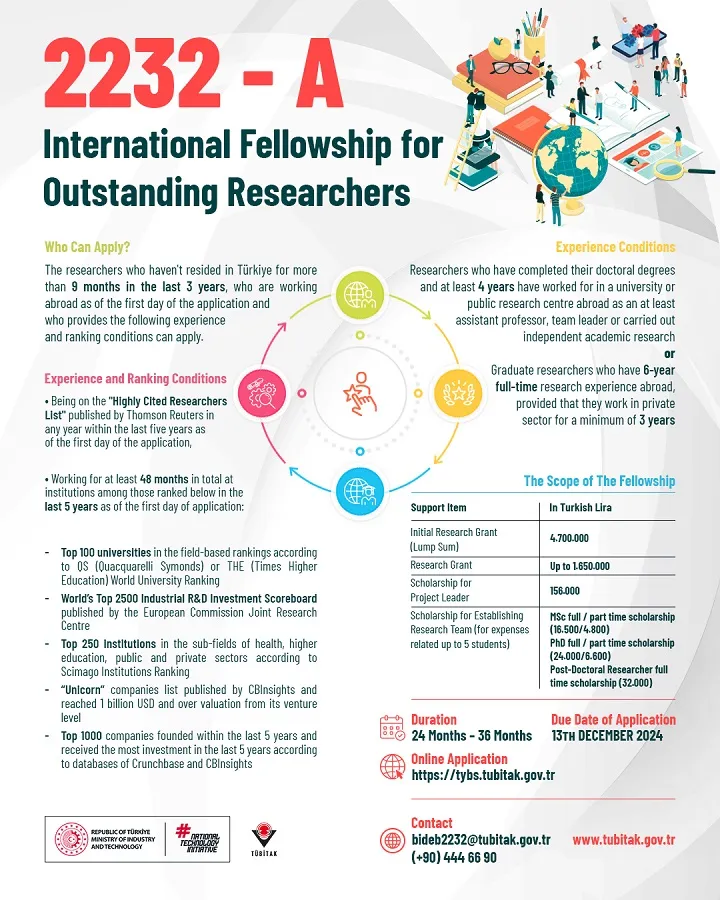
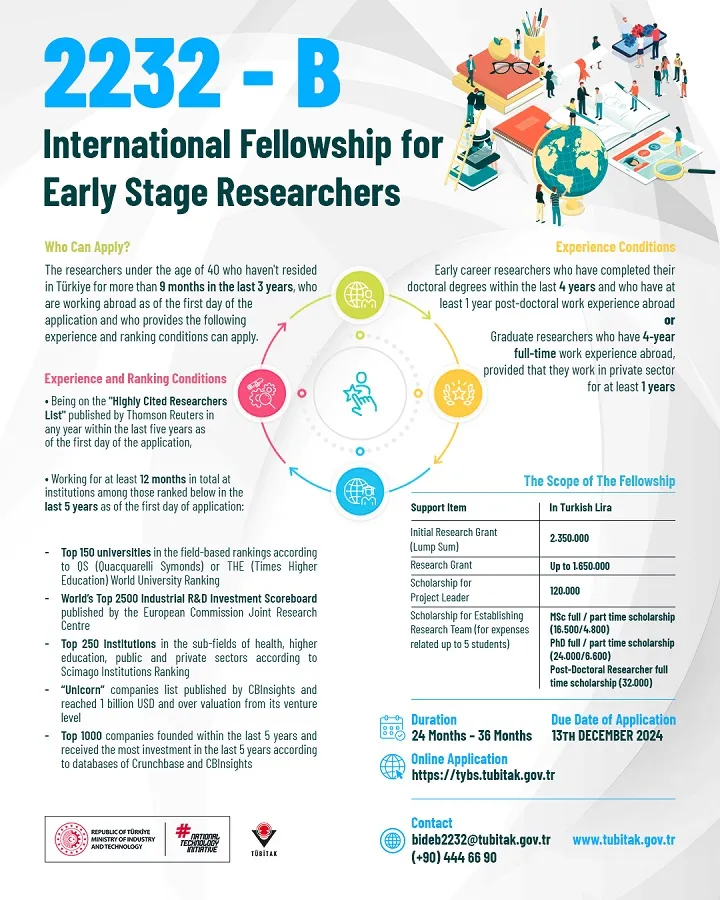
We continue our efforts to accelerate projects that will strengthen Türkiye's position as an independent and leading country in the fields of science, technology, and innovation, contributing significantly to our nation's global competitiveness with the valuable contributions of our esteemed scientists. To encourage qualified researchers, particularly Turkish scientists with high-level scientific and/or technological expertise and experience abroad, to come to Türkiye, we have launched the 2232-A International Fellowship for Outstanding Researchers Programme and the 2232-B International Fellowship for Early-Stage Researchers Programme. The calls for applications for the 2nd Term of the 2024 programmes are now open.
The call calendar for the 2nd Term call of the 2024 2232-A&B International Fellowship for Outstanding/Early-Stage Researchers Programme is as follows.
| Call Term | Opening Date | Closing Date |
| 2024/2 | 23 October 2024 | 13 December 2024 |
Applications will be accepted online at https://tybs.tubitak.gov.tr/ between 23 October 2024 (08:30 AM) and 13/12/2024 (05:30 PM) (UTC+3).
You can access the programme call texts and detailed information about the programme on the programme web pages below:
2232-A International Fellowship for Outstanding Researchers Programme
2232-B International Fellowship for Early-Stage Researchers Programme
Contact: bideb2232@tubitak.gov.tr
Türkiye’nin bilim, teknoloji ve yenilik alanında bağımsız ve lider ülke pozisyonunu güçlendirecek ve ülkemizin dünya çapında rekabet gücünü artıracak çalışmalara, ülkemizdeki değerli bilim insanlarının büyük katkılarıyla hız kazandırılması için çalışmalarımız devam etmektedir. Ülkemiz açısından stratejik değer taşıyan alanlarda yürütülecek projelere katkı sağlamak üzere alanlarında yaptıkları üst seviye bilimsel ve/veya teknolojik çalışmalar ile temayüz etmiş ve yurt dışında çalışma deneyimine sahip başta Türk bilim insanları olmak üzere nitelikli araştırmacıların yurtdışından Türkiye’ye gelmelerini teşvik etmek amacıyla başlattığımız 2232 –A Uluslararası Lider Araştırmacılar Programı ve 2232-B Uluslararası Genç Araştırmacılar Programı 2024 yılı 2. dönem çağrıları başvuruya açılmıştır.
2232-A&B Uluslararası Lider/Genç Araştırmacılar Programları 2024 Yılı 2. Dönem çağrısı başvuru takvimi aşağıdaki gibidir.
| Çağrı Dönemi | Çağrı Açılış Tarihi | Çağrı Kapanış Tarihi |
| 2024/2 | 23 Ekim 2024 | 13 Aralık 2024 |
Başvurular, 23/10/2024 (Saat 08:30) ve 13/12/2024 (Saat 17:30) tarihleri arasında https://tybs.tubitak.gov.tr/ adresi üzerinden çevrimiçi olarak alınacaktır.
Program çağrı metinlerine ve program hakkındaki detaylı bilgilere aşağıda yer alan program web sayfalarından ulaşabilirsiniz:
2232-A Uluslararası Lider Araştırmacılar Programı
2232-B Uluslararası Genç Araştırmacılar Programı
İletişim: bideb2232@tubitak.gov.tr
Within the scope of 1007-Public Institutions Research and Development Projects Support Programme, TÜBİTAK SAVTAG has made a call for the Development of Paper Detectors Used in Chemical Warfare Agent (CWA) Point Detection/Diagnosis Project with Domestic and National Resources with the code 1007-SAVTAG-MSB-2024-02.
The aim of the project is to develop a portable, local and national system used for rapid and reliable detection/diagnosis of Chemical Warfare Agent (CWA) threats in the operational environment.
A CWA detection/diagnosis system will be designed, and it is aimed to develop prototype paper detectors that will be tested environmentally and in the field.
Applicants can receive the Call document request form/ SAVTAG Call Document Delivery Report in accordance with the “Defence Industry Security Regulation” by filling out the “Production Permit and Facility Security Certificate” link at https://www.tubitak.gov.tr/tr/destekler/kamu/ulusal-destek-programlari/1007/icerik-basvuru-. In addition, “Personal Security Certificate” conditions will be sought from all company personnel working on the project (including the authorized courier who will receive the documents).
Project applications within the scope of this call will start to be received on October 30, 2024, and the deadline for project proposals is 30 December 2024 at 17:00.
M. Mustafa BULDUM
Tel: +90 312 298 93 89
mustafa.buldum@tubitak.gov.tr
Dr. Semra TAN
Tel: +90 312 298 93 96
semra.tan@tubitak.gov.tr
Within the framework of the TÜBİTAK 1071 Program, joint research projects will be supported in collaboration between TÜBİTAK and and the Libyan Authority for Scientific Research (LASR) under the 'Protocol on Co-operation in Science, Technology and Innovation” signed the two sides.
Proposals from following areas will be accepted:
Clean, Accessible, and Secure Energy Supply:
Photovoltaic Cells, Panels and Systems
High-Efficiency Concentrated Solar Power Systems
Onshore, Offshore and Airborne Wind Energy Systems
Integrated Biorefineries Supported by Renewable Energy
Autonomous Energy Management Systems
Information and Communication Technologies:
Artificial Intelligence
Big Data
Cloud Computing
General Health and Medical Research:
Epidemiology and Health Services
Pharmaceutical Technologies
Materials Science:
Polymers and Plastics
Metals and Alloys
Ceramics and Composites
Environmental Science:
Purification Technologies
Water treatment and seawater desalination
Turkish researchers willing to propose a joint research project should apply as project partners with the researchers in Libya with whom they will carry out the project. Unilateral project applications will not be accepted.
Applications are only accepted through TÜBİTAK Online Application system.
Application Deadline: 31 January 2025, 23:59 (UTC+3)
E-Signature Deadline: 10 February 2025, 23:59 (UTC+3)
TÜBİTAK 1071 Programı kapsamında, taraflarca imzalanan “Bilim, Teknoloji ve Yenilik Alanlarında İş Birliği Protokolü” çerçevesinde, TÜBİTAK ile Libya Bilimsel Araştırma Kurumu (LASR) iş birliğinde ortak araştırma projeleri desteklenecektir.
Çağrı kapsamında aşağıdaki alanlarda başvuru gerçekleştirilebilecektir:
• Temiz, Erişilebilir ve Güvenli Enerji Arzı:
Fotovoltaik Hücreler, Paneller ve Sistemler
Yüksek Verimli Yoğunlaştırılmış Güneş Enerjisi Sistemleri
Karasal, Kıyı ve Hava Tabanlı Rüzgâr Enerjisi Sistemleri
Yenilenebilir Enerji Destekli Entegre Biyoyakıt Rafinerileri
Otonom Enerji Yönetim Sistemleri
• Bilgi ve İletişim Teknolojileri:
Yapay Zekâ
Büyük Veri
Bulut Bilişim
• Genel Sağlık ve Tıbbi Araştırmalar:
Epidemiyoloji ve Sağlık Hizmetleri
Farmasötik Teknolojiler
• Malzeme Bilimi:
Polimerler ve Plastik;
Metaller ve Alaşımlar;
Seramikler ve Kompozitler
• Çevre Bilimi:
Arıtma Teknolojileri
Su Arıtma ve Deniz Suyunun Tuzdan Arındırılması
Ortak araştırma projesi önermek isteyen Türkiye'deki araştırmacıların, projeyi birlikte gerçekleştirecekleri Libya’daki araştırmacılar ile proje ortağı olarak başvurmaları gerekmektedir. Tek taraflı proje başvuruları kabul edilmemektedir.
Başvurular TÜBİTAK Proje Başvuru Sisteminden gerçekleştirilmektedir.
Son Başvuru Tarihi: 31 Ocak 2025, 23:59
E-imza Son tarihi: 10 Şubat 2025, 23:59
2574 TÜBİTAK - LASR Call Text
Belge
2574 TÜBİTAK - LASR Çağrı Dokümanı
Belge
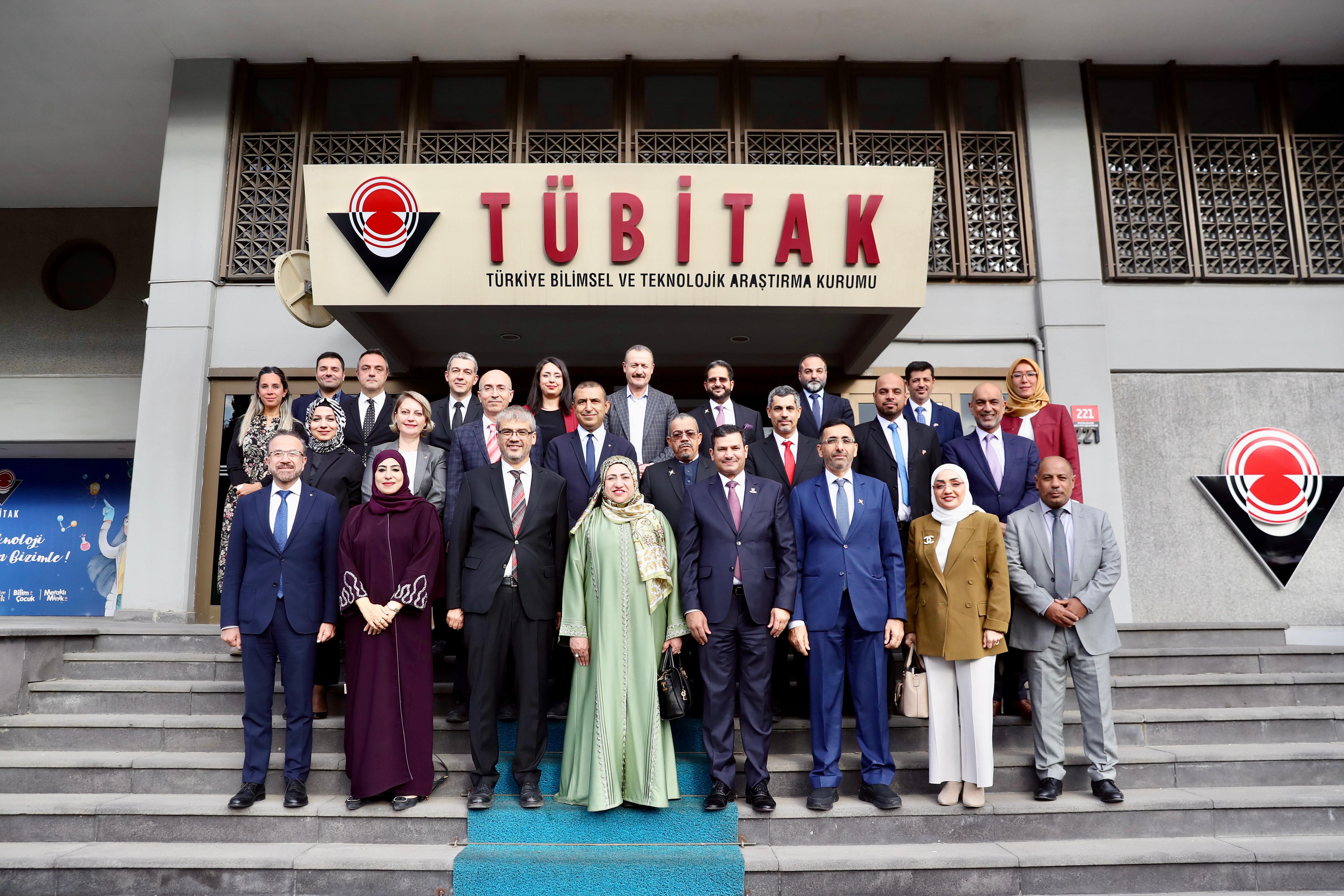
Umman Sultanlığı Yükseköğretim, Araştırma ve Yenilik Bakanı Prof. Dr. Rahma bint Ibrahim Al Mahrooqi ve beraberindeki üst düzey heyet, TÜBİTAK Başkanlık’ta TÜBİTAK Başkanı Prof. Dr. Orhan Aydın başkanlığındaki TÜBİTAK heyetiyle bir araya geldi. Toplantıda iki ülke arasındaki bilimsel ve teknolojik iş birliği fırsatları değerlendirildi.
Prof. Dr. Orhan Aydın, açılış konuşmasında Umman heyetini ağırlamaktan duyduğu memnuniyeti dile getirdi. Uluslararası iş birliğine özel önem verdiklerini vurgulayan Aydın, TÜBİTAK’ın devam eden uluslararası ikili ve çoklu iş birliklerinden örnekler verdi. Potansiyel iş birliği alanlarının ele alındığı toplantıda ikili çağrılar, TÜBİTAK’ın mevcut destekleri ve Merkez ve Enstitüleri tanıtıldı. Ar-Ge ve teknoloji konularında yapılabilecek iş birlikleri üzerine görüş alışverişinde bulunuldu.
Umman Yükseköğretim, Araştırma ve Yenilik Bakanı Al Mahrooqi ise Türkiye’nin bilimsel gelişmelerine duydukları ilgiyi vurguladı. Türkiye ve Umman’ın üniversiteleri, araştırma kurumları ve sanayi kuruluşları arasında iş birliğini destekleyecek projeler geliştirmek istediklerini belirtti.
Umman’da mühendislik ve teknoloji alanlarındaki eğitim programlarının güçlendirilmesiyle yeni sektörlerin oluşumuna odaklanıldığını belirten Al Mahrooqi, uluslararası üniversitelerle iş birliği yaparak eğitimdeki yenilikleri ve en iyi uygulamaları Umman’a kazandırmayı hedeflediklerini dile getirdi. Al Mahrooqi, “Özellikle üniversitelerde inovasyon merkezleri kurulması, eğitim ve araştırma alanında yenilikçi projeleri destekleyecek önemli bir adım olarak görülüyor.” dedi. Bakan Al Mahrooqi, TÜBİTAK ile, su ve çevre, enerji, sağlık, biyoteknoloji, gıda güvenliği ve kuantum teknolojileri gibi belirlenecek stratejik teknoloji alanlarında iş birliğine açık olduklarını belirterek, iki ülkenin öncelikleri doğrultusunda birlikte çalışmak istedikleri vurgusunu paylaştı.
Bu ziyaretin, Umman Yükseköğretim, Araştırma ve Yenilik Bakanlığı ve TÜBİTAK arasında etkileşim ve iş birliği için bir adım olduğu değerlendiriliyor.
Slide görseli
Deadline for application for the call that was issued to support joint research and development projects to be conducted between scientists from Türkiye and Azerbaijan in line with the Cooperation Protocol between TÜBİTAK and the Azerbaijan National Academy of Sciences (ANAS) has been updated to 29 November 2024.
It is important to take into consideration the updated deadline for the project proposals to be submitted within the context of the relevant call.
TÜBİTAK ile Azerbaycan Ulusal Bilimler Akademisi (Azerbaijan National Academy of Sciences – ANAS) arasındaki İşbirliği Protokolü doğrultusunda, Türkiye ve Azerbaycan’dan bilim insanları arasında gerçekleştirilecek olan ortak araştırma ve geliştirme projelerinin desteklenmesine yönelik olarak açılan çağrının son başvuru tarihi 29 Kasım 2024 olarak güncellenmiştir.
İlgili çağrı kapsamında sunulacak proje önerileri için güncellenen son başvuru tarihinin dikkate alınması önem arz etmektedir.
Support Items
Image
Image
How to Apply
The steps listed below are provided as a guide.
First Step, Read the Calls
The first step is very important for you. We have some prerequisites for you to benefit from this funding from TUBITAK. We would like to state in advance that these conditions vary according to the 2232 A International Outstanding Researchers Program and 2232 B International Early Stage Researchers Program. First of all, we expect you to review the following items in the call announcements of the International Fellowship for Outstanding Researchers Program (Read 2232 A Call) or International Fellowship for Early Stage Researchers Program (Read 2232 B Call).
2.2. Amount and Duration of the Fellowship and/or
3. Eligibility Criteria, Required Documents and Application Method
If you are in doubt or unclear about the conditions in these two articles, please contact us. bideb223@tubitak.gov.tr
Second Step, Decide to R&D Organization
It is a pleasure to see you at this stage. The second thing you need to do to conduct your research in Türkiye is to decide which research institution you will work at. Although TÜBİTAK is the organization that will fund you, you need to agree in principle with a research institute or private sector organization where you will conduct your research. On this webpage we have listed the information of some of more than 300 R&D organizations. Also, someone from Türkiye may have already contacted you. If you have not found an R&D organization or if you need help in this regard, please contact us. bideb223@tubitak.gov.tr
Third Step, prepare your research proposal
Congratulations. You have completed the requirements to apply for the program. You have decided to carry out your research in an R&D organization. Now it is time to present to TUBITAK what kind of work you will do in this research organization in TÜRKİYE. Actually, we think that this step is the easiest for you. You may be uncertain about some aspects of your research. For example, in which time frame you will complete the research or how many fellows you will involve. We recommend that you discuss similar issues with the official of the institution where you will conduct your research. We will also provide you with some application forms that we think will be helpful.
Fourth Step, Apply for the program
Now that your research proposal is ready, you can apply to the program. You can log in to the application system with your ARBİS username and password at https://tybs.tubitak.gov.tr/ . During your application, you must fill in the information asked step by step. Please do not leave out any information. We do not expect you to upload any other documents other than your research proposal. However, if there is anything you would like to specify in the application, you can add a petition to the "additional documents" section in the last step. Finally, do not forget to confirm your application because applications that remain as drafts will unfortunately not be taken into consideration
Fifth Step, Eligibility Check
Congratulations you have successfully completed your application. The only thing you need to do now is to check the e-mail you provided in your application. After the application period ends, the Eligibility Check process will begin. At this stage, the applications that do not meet the application criteria will be returned, while those which meet the criteria will proceed to the second stage of the evaluation process. You will receive a notification e-mail for both cases. Also, you can always check the status of your application at https://ebideb.tubitak.gov.tr/
Sixth Step, Scientific Evaluation
The second stage of the evaluation process after the Eligibility Check is the Scientific Evaluation. At this stage, your research proposal will be evaluated by expert panellists according to the following criteria: Your academic career, Your 5-year research plan of, Publication quality constituting the basis of your research, and Qualification of your research project. Scientific evaluation results will be finalised upon the consent of Group Executive Committee and the approval of TÜBİTAK Presidency. You will be informed through a notification e-mail again.
Seventh Step, Information / Document Control
You have finally reached the last stage of the evaluation! At this stage, all you need to do is to upload the required documents to the application system at https://tybs.tubitak.gov.tr/ within the 15-day period given to you. So, the accuracy of the information you declared in your application can be checked. Please note that if you do not upload your documents on time, unfortunately your application will be rejected. After the document control, the results of the calls will be announced. Congratulations if you have been accepted, you will be informed about the next process. If your application was rejected, don't worry, you can apply again. We wish you success.
F.A.Q
Interview about some frequently asked questions.
F.A.Q
Interview about some frequently asked questions.
Can you share the purpose and scope of these calls? What are the target audience and targeted output of the calls?
In our International Fellowship for Outstanding & Early Stage Researchers Programs, we present a mix of support for researchers evaluating the possibility of conducting their research in our country. Before these programs, the needs of leading scientists who preferred to carry out their research in our country were primarily based on individual efforts. In contrast, the scope of our International Fellowship for Outstanding & Early Stage Researchers Programs addresses these needs and beyond with comprehensive incentives and facilitating services. This year's common purpose of our calls is to encourage young and experienced researchers or entrepreneurs, especially Turkish scientists, who are distinguished by their high-level research in their fields and have work experience abroad, to come to our country. We expect them to contribute to significant scientific and technological advances in strategically important research fields with their leading research and to participate in the processes of co-creation and succeeding together.
Can you share the purpose and scope of these calls? What are the target audience and targeted output of the calls?
In our International Fellowship for Outstanding & Early Stage Researchers Programs, we present a mix of support for researchers evaluating the possibility of conducting their research in our country. Before these programs, the needs of leading scientists who preferred to carry out their research in our country were primarily based on individual efforts. In contrast, the scope of our International Fellowship for Outstanding & Early Stage Researchers Programs addresses these needs and beyond with comprehensive incentives and facilitating services. This year's common purpose of our calls is to encourage young and experienced researchers or entrepreneurs, especially Turkish scientists, who are distinguished by their high-level research in their fields and have work experience abroad, to come to our country. We expect them to contribute to significant scientific and technological advances in strategically important research fields with their leading research and to participate in the processes of co-creation and succeeding together.
Can you share the purpose and scope of these calls? What are the target audience and targeted output of the calls?
In our International Fellowship for Outstanding & Early Stage Researchers Programs, we present a mix of support for researchers evaluating the possibility of conducting their research in our country. Before these programs, the needs of leading scientists who preferred to carry out their research in our country were primarily based on individual efforts. In contrast, the scope of our International Fellowship for Outstanding & Early Stage Researchers Programs addresses these needs and beyond with comprehensive incentives and facilitating services. This year's common purpose of our calls is to encourage young and experienced researchers or entrepreneurs, especially Turkish scientists, who are distinguished by their high-level research in their fields and have work experience abroad, to come to our country. We expect them to contribute to significant scientific and technological advances in strategically important research fields with their leading research and to participate in the processes of co-creation and succeeding together.
Can you please mention the results of the previous calls of the programs and the high impact/contribution that they created? From how many countries were researchers supported? How was the distribution based on research areas and success rate realized?
In the previous calls of our International Fellowship for Outstanding & Early Stage Researchers Programs, we supported 201 scientists who are pioneers in science and technology to our ecosystem from 28 different countries. These researchers, including a Nobel Peace Prize winner, have pioneering projects involving high risk with groundbreaking contributions and high-impact potential. Our researchers continue to demonstrate their pioneering contributions in areas that require essential solutions such as healthy living, sustainable environment, digital transformation, and advanced production. Our researchers are working on protein chemistry and protein engineering, cellular energy metabolism, climate change, lake restoration, medical and smart capsule robots, radiology and computer systems, neuroscience, artificial intelligence, new generation energy storage, and new chemical transformation clean and safe energy, processes, smart cities, composite aviation structures, and predictive maintenance systems. Each of our leading researchers is also raising five graduate students or post-doctoral researchers as an example of co-creation-oriented human resources while strengthening their teams.
According to the results of our previous calls, 93 of our researchers conducted or are conducting groundbreaking projects in the fields of technical sciences, 47 in basic sciences, 11 in social and humanities, 7 in health and life sciences, and 1 in agricultural sciences. Seventy-four of our researchers came to our country to conduct their research in our ecosystem from the United States. Other countries with the highest number of researchers are England, Germany, and the Netherlands. In a short time, our researchers integrated into our ecosystem and contributed to our impact-oriented processes.
These crucial developments were possible by supporting the most qualified applications that we received. The overall success rate for our first call was 52%. Of the 359 applicants who met the high criteria we put forth, 260 were from the top 150 universities globally in their field, 36 were from global companies with the most R&D expenditure, and 46 were from the first 250 public institutions.
The calls of the programs set expectations for "Outstanding Researchers" and "Early Stage Researchers". What are the application conditions? What work experience conditions need to be satisfied so that researchers can be candidates for applying to these programs?
Under the calls of the TÜBİTAK 2232 Program that are opened as 2232-A and 2232-B, we have set conditions for outstanding researchers who are experienced and young, respectively. The common conditions we consider are being among the most cited researchers based on the list published by Thomson Reuters or working in a leading institution or firm. We expect these institutions to be among the first 100 universities in the field for experienced researchers or 150 universities for young researchers, the first 2500 companies that make the most R&D spending, the first 250 public institutions and institutes (including health, public institutions, or non-profit institutions) or successful start-ups and Unicorn companies. The evaluation of these conditions is based on the QS or THE World University Rankings, European Commission JRC Industrial R&D Scoreboard, Scimago, CBInsights, or Crunchbase resources. For experienced researchers, the duration of working abroad is expected to be at least a total of 4-6 years, while for young researchers, this period is 1-4 years. In addition, work experience in universities, companies, or public institutions and institutes that meet the above conditions is expected to be at least 48 months for experienced researchers and 12 months for young researchers during this time.
Could we also hear from you regarding options for the relations with the institutions where the researchers are currently working?
At a time when TÜBİTAK has put forward an approach of co-creation and succeeding together for our ecosystem, one of the most important features to which we give importance as an institution is based on our ability to manage our processes in a more agile and flexible manner. This feature is also reflected in researchers who may be candidates within the scope of our 2232 calls to shape their options for the institutions and firms they are currently working. Our researchers can receive sabbaticals from the institutions or firms and return after the support duration, postpone the need to decide for a particular time or make this decision at an earlier time. All of these options are possible. In addition, as we have stated in our call, our researchers can be abroad for up to 3 months each year while their support continues. This period can further be spent in the institutions and organizations they have worked full time before. In this way, we are especially encouraging our researchers to pursue their research links and to facilitate the transfer of knowledge.
Could you please indicate the support provided to the researcher and his/her research within the scope of the programs? What do these programs promise for supported scientists and researchers who wish to conduct research in Türkiye and contribute to Türkiye's advancement in technology and innovation?
In our calls, we provide opportunities for our researchers to realize their research objectives in our country and encourage them to work with our country's ecosystem and achieve new achievements. We offer a package of 10 different fellowships and support incentives to the researcher, the research project, the research team, and his/her family comprehensively. In this context, monthly scholarship for the coordinator during the support period, initial research grant that is given as a fixed sum at the beginning of the project, support for the research project with a duration of at least 24 and at most 36 months according to the content of the research project, scholarship expenses for five graduate students or post-doctoral researchers for strengthening research teams, project incentive bonus for researchers who will take part in the research project, and an institution share for the host institution or organization. In addition to the research project support, which varies from project to project and amounts to a maximum of 1.650.000 thousand Turkish Liras, the initial research grant is given as 4.700.000 Turkish Liras for experienced leading researchers and 2.350.000 Turkish Liras for young researchers. In addition, a family life expense scholarship and travel support for the arrival to Türkiye for the coordinator, spouse, and children, if any, and health insurance support are provided. As a new incentive, mentoring support is provided by our International Leading Researchers, who were previously supported in the previous calls. This incentive will also provide essential guidance for increasing the impact potential of our researchers within our ecosystem. Moreover, if the education period of the graduate students who are scholarship holders exceeds the project duration, our support continues.
Within the scope of the application, host institutions and firms are expected to submit an invitation letter. How does this process work? What are the criteria that the domestic host institution is expected to meet?
The host institution or firms, which will host the researchers in our ecosystem, are expected to be leading state or foundation higher education institutions, research infrastructure that have received research and managerial competence in critical fields, public research institutes, firms with R&D or design centers or companies that established within technoparks. The institutions or firms that intend to be hosts are also expected to present an invitation letter. Depending on the researcher's ties to our country, both sides may have initiated this process. According to the host institution or firm, the invitation letter is expected to be signed by the rector or vice-rector, the director of the research infrastructure, or the top-level representative of private sector institutions. In the support process, if the host institution is a public institution or a state university, we cover 100% of the support items. If the host institution or organization is a foundation university or SME, 25% of the scholarship amount is expected to be covered, or 40% if it is a large-scale company. In these cases, based on the call, TÜBİTAK covers the remaining percentage.
It is a great flexibility that the application documents can be submitted online in the application system. Could you please share any other information that will be useful for the applicant?
Our application forms are made online through one of the electronic application and tracking systems of the TÜBİTAK, called the TYBS system (https://tybs.tubitak.gov.tr/). All procedures are carried out through the TYBS system upon logging into the system, including the approval of the application file created in the system. We also share all the details regarding the process within the scope of our calls.
Where would you recommend our scientists who want to apply for the International Fellowship for Outstanding and Early Stage Researchers Programs Calls to start? As far as we know, researchers benefiting from the programs can share information and experience with the researchers who plan to apply. Can you explain this possibility?
After examining the information on our website, we recommend that the preparation starts as soon as possible by contacting the institutions and organizations of our ecosystem. Our leading international researchers, whom we supported in our previous calls, will provide contributions within the scope of mentoring support. The knowledge and experience provided by our leading researchers from top research universities such as Harvard, Stanford, Columbia, Princeton, MIT, and Yale, global R&D companies such as Amazon, Apple, and Intel, and public research centers such as Argonne National Laboratory will help guide the preferences and application preparations of researchers in following a similar path. Here are the websites for more information;
Can you share the purpose and scope of these calls? What are the target audience and targeted output of the calls?
In our International Fellowship for Outstanding & Early Stage Researchers Programs, we present a mix of support for researchers evaluating the possibility of conducting their research in our country. Before these programs, the needs of leading scientists who preferred to carry out their research in our country were primarily based on individual efforts. In contrast, the scope of our International Fellowship for Outstanding & Early Stage Researchers Programs addresses these needs and beyond with comprehensive incentives and facilitating services. This year's common purpose of our calls is to encourage young and experienced researchers or entrepreneurs, especially Turkish scientists, who are distinguished by their high-level research in their fields and have work experience abroad, to come to our country. We expect them to contribute to significant scientific and technological advances in strategically important research fields with their leading research and to participate in the processes of co-creation and succeeding together.
Can you please mention the results of the previous calls of the programs and the high impact/contribution that they created? From how many countries were researchers supported? How was the distribution based on research areas and success rate realized?
In the previous calls of our International Fellowship for Outstanding & Early Stage Researchers Programs, we supported 201 scientists who are pioneers in science and technology to our ecosystem from 28 different countries. These researchers, including a Nobel Peace Prize winner, have pioneering projects involving high risk with groundbreaking contributions and high-impact potential. Our researchers continue to demonstrate their pioneering contributions in areas that require essential solutions such as healthy living, sustainable environment, digital transformation, and advanced production. Our researchers are working on protein chemistry and protein engineering, cellular energy metabolism, climate change, lake restoration, medical and smart capsule robots, radiology and computer systems, neuroscience, artificial intelligence, new generation energy storage, and new chemical transformation clean and safe energy, processes, smart cities, composite aviation structures, and predictive maintenance systems. Each of our leading researchers is also raising five graduate students or post-doctoral researchers as an example of co-creation-oriented human resources while strengthening their teams.
According to the results of our previous calls, 93 of our researchers conducted or are conducting groundbreaking projects in the fields of technical sciences, 47 in basic sciences, 11 in social and humanities, 7 in health and life sciences, and 1 in agricultural sciences. Seventy-four of our researchers came to our country to conduct their research in our ecosystem from the United States. Other countries with the highest number of researchers are England, Germany, and the Netherlands. In a short time, our researchers integrated into our ecosystem and contributed to our impact-oriented processes.
These crucial developments were possible by supporting the most qualified applications that we received. The overall success rate for our first call was 52%. Of the 359 applicants who met the high criteria we put forth, 260 were from the top 150 universities globally in their field, 36 were from global companies with the most R&D expenditure, and 46 were from the first 250 public institutions.
The calls of the programs set expectations for "Outstanding Researchers" and "Early Stage Researchers". What are the application conditions? What work experience conditions need to be satisfied so that researchers can be candidates for applying to these programs?
Under the calls of the TÜBİTAK 2232 Program that are opened as 2232-A and 2232-B, we have set conditions for outstanding researchers who are experienced and young, respectively. The common conditions we consider are being among the most cited researchers based on the list published by Thomson Reuters or working in a leading institution or firm. We expect these institutions to be among the first 100 universities in the field for experienced researchers or 150 universities for young researchers, the first 2500 companies that make the most R&D spending, the first 250 public institutions and institutes (including health, public institutions, or non-profit institutions) or successful start-ups and Unicorn companies. The evaluation of these conditions is based on the QS or THE World University Rankings, European Commission JRC Industrial R&D Scoreboard, Scimago, CBInsights, or Crunchbase resources. For experienced researchers, the duration of working abroad is expected to be at least a total of 4-6 years, while for young researchers, this period is 1-4 years. In addition, work experience in universities, companies, or public institutions and institutes that meet the above conditions is expected to be at least 48 months for experienced researchers and 12 months for young researchers during this time.
Could we also hear from you regarding options for the relations with the institutions where the researchers are currently working?
At a time when TÜBİTAK has put forward an approach of co-creation and succeeding together for our ecosystem, one of the most important features to which we give importance as an institution is based on our ability to manage our processes in a more agile and flexible manner. This feature is also reflected in researchers who may be candidates within the scope of our 2232 calls to shape their options for the institutions and firms they are currently working. Our researchers can receive sabbaticals from the institutions or firms and return after the support duration, postpone the need to decide for a particular time or make this decision at an earlier time. All of these options are possible. In addition, as we have stated in our call, our researchers can be abroad for up to 3 months each year while their support continues. This period can further be spent in the institutions and organizations they have worked full time before. In this way, we are especially encouraging our researchers to pursue their research links and to facilitate the transfer of knowledge.
Could you please indicate the support provided to the researcher and his/her research within the scope of the programs? What do these programs promise for supported scientists and researchers who wish to conduct research in Türkiye and contribute to Türkiye's advancement in technology and innovation?
In our calls, we provide opportunities for our researchers to realize their research objectives in our country and encourage them to work with our country's ecosystem and achieve new achievements. We offer a package of 10 different fellowships and support incentives to the researcher, the research project, the research team, and his/her family comprehensively. In this context, monthly scholarship for the coordinator during the support period, initial research grant that is given as a fixed sum at the beginning of the project, support for the research project with a duration of at least 24 and at most 36 months according to the content of the research project, scholarship expenses for five graduate students or post-doctoral researchers for strengthening research teams, project incentive bonus for researchers who will take part in the research project, and an institution share for the host institution or organization. In addition to the research project support, which varies from project to project and amounts to a maximum of 1.650.000 thousand Turkish Liras, the initial research grant is given as 4.700.000 Turkish Liras for experienced leading researchers and 2.350.000 Turkish Liras for young researchers. In addition, a family life expense scholarship and travel support for the arrival to Türkiye for the coordinator, spouse, and children, if any, and health insurance support are provided. As a new incentive, mentoring support is provided by our International Leading Researchers, who were previously supported in the previous calls. This incentive will also provide essential guidance for increasing the impact potential of our researchers within our ecosystem. Moreover, if the education period of the graduate students who are scholarship holders exceeds the project duration, our support continues.
Within the scope of the application, host institutions and firms are expected to submit an invitation letter. How does this process work? What are the criteria that the domestic host institution is expected to meet?
The host institution or firms, which will host the researchers in our ecosystem, are expected to be leading state or foundation higher education institutions, research infrastructure that have received research and managerial competence in critical fields, public research institutes, firms with R&D or design centers or companies that established within technoparks. The institutions or firms that intend to be hosts are also expected to present an invitation letter. Depending on the researcher's ties to our country, both sides may have initiated this process. According to the host institution or firm, the invitation letter is expected to be signed by the rector or vice-rector, the director of the research infrastructure, or the top-level representative of private sector institutions. In the support process, if the host institution is a public institution or a state university, we cover 100% of the support items. If the host institution or organization is a foundation university or SME, 25% of the scholarship amount is expected to be covered, or 40% if it is a large-scale company. In these cases, based on the call, TÜBİTAK covers the remaining percentage.
It is a great flexibility that the application documents can be submitted online in the application system. Could you please share any other information that will be useful for the applicant?
Our application forms are made online through one of the electronic application and tracking systems of the TÜBİTAK, called the TYBS system (https://tybs.tubitak.gov.tr/). All procedures are carried out through the TYBS system upon logging into the system, including the approval of the application file created in the system. We also share all the details regarding the process within the scope of our calls.
Where would you recommend our scientists who want to apply for the International Fellowship for Outstanding and Early Stage Researchers Programs Calls to start? As far as we know, researchers benefiting from the programs can share information and experience with the researchers who plan to apply. Can you explain this possibility?
After examining the information on our website, we recommend that the preparation starts as soon as possible by contacting the institutions and organizations of our ecosystem. Our leading international researchers, whom we supported in our previous calls, will provide contributions within the scope of mentoring support. The knowledge and experience provided by our leading researchers from top research universities such as Harvard, Stanford, Columbia, Princeton, MIT, and Yale, global R&D companies such as Amazon, Apple, and Intel, and public research centers such as Argonne National Laboratory will help guide the preferences and application preparations of researchers in following a similar path. Here are the websites for more information;