

Arama
+
-
0
Scope of Support
The scope of the call is within the framework of the Priority R&D and Innovation Topics in Compliance with the Green Deal
Burs Başlatma Belgeleri
Bursun Başlatılabilmesi İçin İstenilen Belgeler
Burs başlatma, kefalet senedi ve seyahat işlemleri hakkında bilgi notuna aşağıdaki link üzerinden erişebilirsiniz.
Bursiyerin bursunu başlatma talebine ilişkin dilekçesi,*
Türk dış temsilcilik veya Noterce onaylanmış;
Yüklenme ve Müşterek Borçlu ve Müteselsil Kefalet Senedi ve kefilin gelir belgesiveya
Yüklenme Senedi ve Teminat Mektubu.**
Aday bir kuruluşta çalışıyorsa, çalıştığı kurum/kuruluş tarafından verilecek antetli kağıda hazırlanmış araştırma süresi boyunca görevli veya izinli sayılacağını gösteren kurum/kuruluşun en üst yetkilisi tarafından imzalı belge (Aday üniversitede çalışıyor ise belge Rektör tarafından imzalanmalı veya Rektör adına imzalı olmalıdır, bakanlıkta çalışıyor ise belge Bakan tarafından imzalanmalı veya Bakan adına imzalı olmalıdır.) ***
Seyahat Vizesi.****
*Burs başlatma belgelerinin Bilim İnsanı Destek Programları Başkanlığı’na iletilmesini takiben bursiyer, e-bideb sistemi üzerinden banka bilgilerini girmelidir. Banka bilgilerini sistem üzerinden girmeyen bursiyerlerin burs başlatma belgelerini iletmiş olsalar dahi burs ödemeleri gerçekleştirilmeyecektir.
**Teminat mektubu müteselsil kefalet senedinin alternatifidir. Eğer müteselsil kefalet senedi gönderilirse teminat mektubu gönderme zorunluluğu bulunmamaktadır.
| Teminat Mektubu Tutarı | Teminat Mektubu Süresi |
| Verilecek toplam destek miktarının %30 fazlası | Araştırmanın tamamlanması gereken sürenin 18 ay fazlası |
***2219 Yurt Dışı Doktora Sonrası Araştırma Burs Programında talep edilen “Bursiyer, çalışıyorsa çalıştığı kurum/kuruluş tarafından verilecek kurum/kuruluş yetkilisi imzalı, araştırma süresince görevli veya izinli sayılacağını gösteren belge”nin araştırma süresini kapsayacak şekilde alınamaması durumunda, 3’er aylık dönemler itibariyle uzatmaya da izin verecek şekilde düzenlenmiş izin yazıları kabul edilebilecektir. Araştırma süresini kapsayan kurum izni sunamayan bursiyerlerin mevcut kurum izinleri süresince burs ödemesi yapılır. Bursiyerler, kalan süreyi kapsayan kurum izinlerini program mail adresine (bideb2219@tubitak.gov.tr) iletmelidir. Kalan süreyi kapsayan kurum izinlerini iletmeyen bursiyerlerin ödemeleri durdurulur. Yeni tarihli kurum iznini ileten bursiyerlerin burs ödemeleri kesinti yapılmaksızın kaldığı yerden devam eder. Kurum izinlerinin süresi içerisinde temini, kuruma iletilmesi ve bu nedenle burs ödemelerinde yaşanacak gecikmeler bursiyerin sorumluluğundadır.
****Araştırma yapılacak ülkenin seyahat vizesi talep etmesi halinde vize alındığına ilişkin belge sunulmadan burs başlatma işlemi gerçekleştirilmeyecektir. Burs süresini kapsayan, ilgili ülkeye seyahate izin veren belgesi olanların (3 aylık bursiyerler için Hususi (yeşil) pasaport gibi) vize yerine bu belgeyi burs başlatma belgeleri ile birlikte sunmaları gerekmektedir.
DUYURU (01.06.2026): 2221 - Konuk veya Akademik İzinli (Sabbatical) Bilim İnsanı Destekleme Programı 2026 yılı 2. dönem son başvuru tarihi 08 Haziran 2026 (Saat 17:30) tarihine kadar uzatılmıştır.
Doktorasını tamamlamış ve yurt dışında doktora derecesi gerektiren bir işte çalışan konuk/akademik izinli bilim insanlarının (başvuru tarihi itibariyle en az 4 yıl süre ile bir üniversite, araştırma merkezi veya özel sektörde çalışıyor olması) Türkiye’ye gelmeleri teşvik edilerek,
Araştırma yapma,
Laboratuvarda çalışma,
Ürün geliştirme,
Konferans/kongre düzenleme,
Seminer verme,
Kısmi zamanlı eğitim verme,
Ortak proje yazma
gibi her türlü akademik ve Ar-Ge faaliyetlerini gerçekleştirmesine destek verilmektedir.
Ayrıca, Akademik İzin Dönemini (sabbatical) Türkiye’de geçirmek isteyen bilim insanları da program kapsamında desteklenmektedir.
Program çağrı duyurusuna ulaşmak için lütfen görsele tıklayınız.
DUYURU (01.06.2026): 2221 - Konuk veya Akademik İzinli (Sabbatical) Bilim İnsanı Destekleme Programı 2026 yılı 2. dönem son başvuru tarihi 08 Haziran 2026 (Saat 17:30) tarihine kadar uzatılmıştır.
Doktorasını tamamlamış ve yurt dışında doktora derecesi gerektiren bir işte çalışan konuk/akademik izinli bilim insanlarının (başvuru tarihi itibariyle en az 4 yıl süre ile bir üniversite, araştırma merkezi veya özel sektörde çalışıyor olması) Türkiye’ye gelmeleri teşvik edilerek,
Araştırma yapma,
Laboratuvarda çalışma,
Ürün geliştirme,
Konferans/kongre düzenleme,
Seminer verme,
Kısmi zamanlı eğitim verme,
Ortak proje yazma
gibi her türlü akademik ve Ar-Ge faaliyetlerini gerçekleştirmesine destek verilmektedir.
Ayrıca, Akademik İzin Dönemini (sabbatical) Türkiye’de geçirmek isteyen bilim insanları da program kapsamında desteklenmektedir.
Program çağrı duyurusuna ulaşmak için lütfen görsele tıklayınız.
Türkiye Cumhuriyeti Hükümeti ile Slovenya Cumhuriyeti Hükümeti arasında 19 Nisan 2001 tarihinde Ljubljana'da imzalanan Bilimsel ve Teknolojik İşbirliği Anlaşması çerçevesinde Türkiye Bilimsel ve Teknolojik Araştırma Kurumu (TÜBİTAK) ile Slovenya Araştırma ve Yenilik Ajansı (ARIS) arasında 2024 yılında açılan ikili iş birliği çağrısı kapsamında aşağıdaki projelerin desteklenmesine karar verilmiştir.
| Türkiye’deki Proje Yürütücüsü | Slovenya’daki Proje Yürütücüsü | Proje Başlığı |
FÜSUN AKGÜL Burdur Mehmet Akif Ersoy Üniversitesi | KATJA KLUN National Institute of Biology, Marine Biology Station, SLOVENIA | Sečovlje Tuzlalarından İzole Edilen Halofilik Mikroalg/Siyanobakterilerin Biyoaktif Madde Üretimi Ve Uyum Mekanizmalarının Terapötik Bir Yaklaşımla Araştırılması (Halgact) |
CEREN KARAMAN Akdeniz Üniversitesi | MATJAZ FINŠGAR University of Maribor | Leukosense: Lösemi Tedavilerinin Hassas İzlenmesi İçin Karbon Hibrid Nanoyapı Temelli Yeni Nesil Dna-Biyosensörler |
TUĞBA BAĞCI ÖNDER Koç Üniversitesi | BARBARA BREZNIK National Institute of Biology, Slovenia (NIB) | Arjinin Metiltransferaz Inhibitörleri ve Radyoterapi Kombinasyon Tedavisinin Glioblastoma Organoidleri Üzerindeki Etkilerinin İncelenmesi |
ŞAHİN KÖK Çanakkale Onsekiz Mart Üniversitesi | STANISLAV TRDAN Biotechnical Faculty, University of Ljubljana, Slovenia | Türkiye Ve Slovenya'da Tarım Alanlarına Bitişik Sulak Alan Habitatlarındaki Yerel Phytoseiid Akarların (Acari: Phytoseiidae) ve Biyolojik Mücadele Ajanı Olarak Potansiyellerinin Belirlenmesi |
MEHMET BATU ERMAN Acıbadem Mehmet Ali Aydınlar Üniversitesi | ARIO DE MARCO Nova Gorici University, Slovenia | Interleukin-1 Receptor Antagonist/Anakinra Protein Seviyelerini Ölçecek Nanokor Tabanlı Bir Medikal Diyagnostik Kit Geliştirilmesi |
HÜSEYİN ARBAĞ Gazi Üniversitesi | ILJA GASAN OSOJNIK ČRNIVEC National Institute of Chemistry/Slovenia | Ayarlanmış Adsorpsiyon/Absorpsiyon Özelliklerine Sahip Gelişmiş Biyo-Bazlı Fonksiyonel Malzemelerle Bor Giderimi |
HÜSEYİN SİVRİKAYA Bartın Üniversitesi | LAETITIA SARAH MARROT ZAG Slovenian National Building And Civil Engineering Institute, Department for Fire-Safe Sustainable Built Environment (FRISSBE) | Kömürleştirme ve Sürdürülebilir Biyobazlı Yangın Geciktirici Işlemler Yoluyla Ahşap Yapıların Yangın Performansının Iyileştirilmesi |
MERAL KEKEÇOĞLU Düzce Üniversitesi | ALEŠ GREGORC University of Maribor | Uv-B Radyasyonunun Farklı Bal Arısı (Apis Mellifera L.) Alt Türlerinin Davranışı Ve Fizyolojisi Üzerindeki Etkileri |
2566–Çin Ulusal Doğa Bilimleri (NSFC) ile İkili İşbirliği Programı 2025 yılı çağrısı değerlendirme süreci sonuçlandı. TÜBİTAK ve NSFC tarafından desteklenmesine karar verilen toplam 8 projeye ilişkin bilgiler aşağıda paylaşılmaktadır.
| Türkiye’deki Proje Yürütücüsü | Çin’deki Proje Yürütücüsü | Proje Başlığı |
Prof. Dr. Abdulkadir Bayır Atatürk Üniversitesi | Prof. Dr. Chunfang Wang Huazhong Tarım Üniversitesi | Balık Beslenme Davranışını Düzenleyen Hedefe Yönelik Besinsel Etken Moleküllerinin Mekanizması ve Akıllı Yemleme Yönetiminde Uygulanması |
Prof. Dr. Deniz Nazire Çağdaş Ayvaz Hacettepe Üniversitesi | Prof. Dr. Yikun Yao Çin Bilimler Akademisi Şangay Beslenme ve Sağlık Enstitüsü | Doğumsal İmmünite Hatalarında Karsinogenez Mekanizmaları ve Kanser İmmünoterapisi |
Prof. Dr. Erkan Tuncay Ankara Üniversitesi | Prof. Dr. Huaqian Yang Soochow Üniversitesi | Klinik Olarak Onaylı PD-1 İnhibitörlerinin Kardiyak İyon Kanalları Üzerindeki Etkilerinin ve Aritmi Oluşturma Mekanizmalarının Araştırılması |
Prof. Dr. Hasan Türkez Atatürk Üniversitesi | Prof. Dr. Xuexin Li Çin Tıp Üniversitesi | Bub1'in Berrak Hücreli Renal Hücreli Karsinomda İlaçla Hedeflenebilirliğinin Yapay Zekâ ve Büyük Veri Tabanlı Değerlendirmesi: Moleküler Tasarımdan Mekanistik Analize |
Prof. Dr. Murat Kaya İstanbul Teknik Üniversitesi | Prof. Dr. Lian-Sheng Zang Guizhou Üniversitesi | Yüksek Verimli Biyopestisit Taşınımı için İpekböceği Atıklarından Kitin-Protein Nanotaşıyıcıların Geliştirilmesi |
Dr. Öğr. Üyesi Onur Öztaş Koç Üniversitesi | Prof. Dr. Huairong Pan Hunan Üniversitesi | Enfekte Olmamış Kök Nodül Hücrelerinde Karbon ve Azot Metabolik Ağının Transkripsiyonel Düzenlenmesi ve Bunun Yoncanın Akıllı Tasarımına Uygulanması |
Prof. Dr. Pınar Çalık Orta Doğu Teknik Üniversitesi | Prof. Dr. Jianguo Zhang Şangay Bilim ve Teknoloji Üniversitesi | Tarım ve Gıda İşletme Atıklarının Geri-Dönüştürülmüş Karbon Kaynaklarından Antimikrobiyal Peptit Üretimi için Komagataella Phaffii Hücrelerinde Metabolik Mühendislik |
Doç. Dr. Yunus Emre TUNÇİL Necmettin Erbakan Üniversitesi | Prof. Dr. Bin Zhang Güney Çin Teknoloji Üniversitesi | Fındık Yağı Endüstrisi Atığının Yeşil Teknoloji ile İnsan Bağırsak Mikrobiyotasına Yönelik Katma Değerli Ürüne Dönüştürülmesi |
TÜBİTAK Uluslararası İşbirliklerine Katılımı Özendirmeye Yönelik Destek ve Ödül Programları
Türkiye Bilimsel ve Teknolojik Araştırma Kurumu (TÜBİTAK) tarafından bilim, teknoloji ve yenilik çevrelerinin uluslararası işbirliği programlarına katılımlarını özendirmek ve bu yolla, ülkemizin uluslararası işbirliği programlarından en yüksek düzeyde faydalanmasını sağlamak amacıyla “Uluslararası İşbirliklerine Katılımı Özendirmeye Yönelik Destek ve Ödül Programları” yürütülmektedir.
Türkiye’de faaliyet gösteren kuruluşların Avrupa Birliği Çerçeve Programları (AB ÇP) kapsamındaki araştırma, geliştirme ve yenilik faaliyetlerine etkin katılımını sağlamak amacıyla yürütülen destek ve ödül programlarına ait güncel verilere link üzerinden erişilebilmektedir.
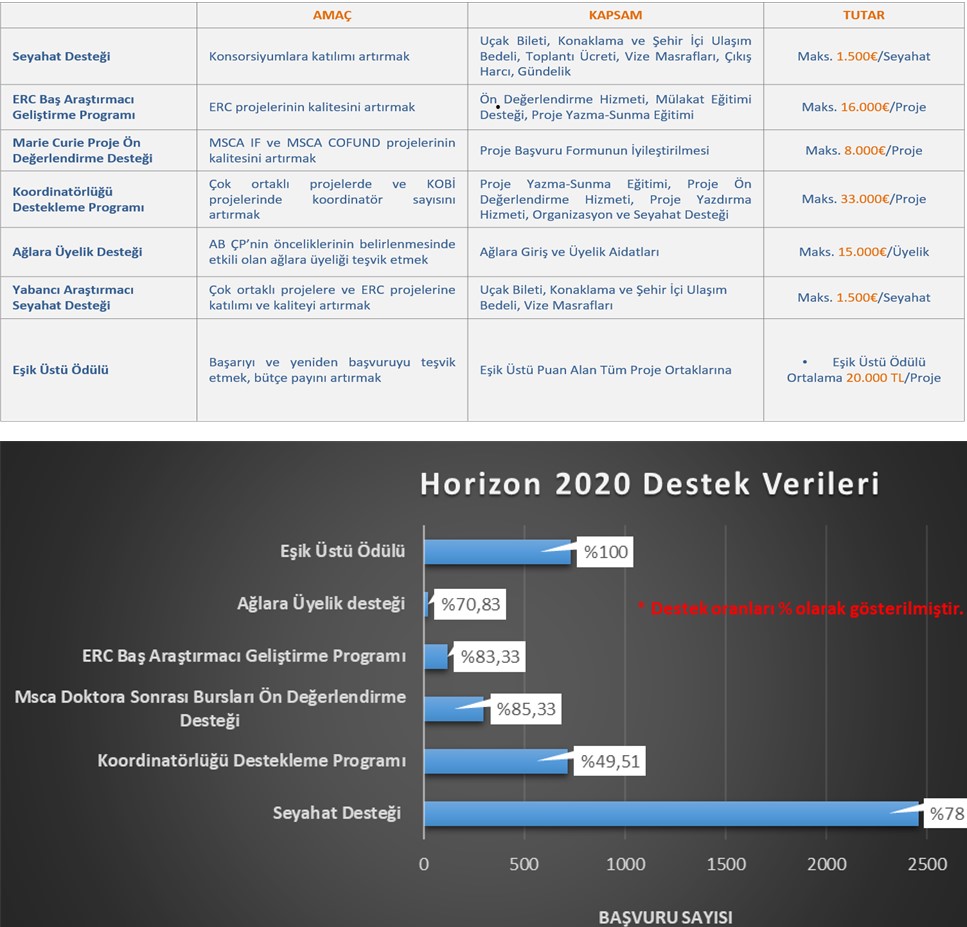
Marie Skłodowska-Curie Proje Ön Değerlendirme Desteği
ERC Baş Araştırmacı Geliştirme Programı
Yabancı Araştırmacı Seyahat Desteği
Initiation of the Project
The researcher to be supported should start his research by sending the following documents as soon as possible after the support decision. The coordinator may request to postpone the project start date for a maximum of 6 months due to force majeure.
In case the coordinator is working in public research centers, the letter of approval to be obtained from the highest official of the public institution to which the relevant public research center is affiliated,
It should be obtained before research if the study requires any legal / special permission certificate and/or Ethics Committee certificate (animal experiments ethics committees, clinical trials ethics committees and non-interventional human trials ethics committees).
(See TÜBİTAK Ethics Committee Approval Document Information Note and TÜBİTAK Legal / Special Permit Information Note)
Project proposal and "Approved Application Document" which was automatically generated by the system during applicationThe original or certified copy of the diploma or graduation certificate related to the latest education (a certified Turkish translation of the diploma other than Turkish or English must be sent.
If any, the support letters to be received from the people / institutions / organizations to be benefited within the scope of the project
PORTABLE ULTRASONIC POWER METER (PUG) DEVICE
* It was published in the Official Gazette dated 06/08/2018 and numbered 30501.
"Portable Ultrasonic Power Meter (PUG) Device Technology" developed by TÜBİTAK will be transferred via non-exclusive licensing method for 5 (five) years in return for a technology transfer fee.
Technology Transfer Fee ((₺ (TL), Excluding VAT)
Advance Payment
100.000
Royalty
10% Royalty on the Sales Price of the Products Produced by the Licensee Using the Technology Subject to Transfer
Technology Transfer Method
Non-Exclusive Licence
Transfer Period
5 Years
INFORMATION ABOUT TECHNOLOGY
The technology is related to the calibration of the output powers of probes belonging to the ultrasonographic diagnostic (imaging) and treatment devices. With the help of the invention, the output powers of probes that is related to ultrasound diagnostic (imaging) and treatment devices can be determined.
The ultrasonic power meter device that makes ultrasonic power measurement from one place to another easily as a portable way, facilitates effective decision-making on the working performance of ultrasonic probes in order to determine whether the ultrasonic probes have the 5 output power specified in the manufacturer's catalogs for the purpose of determining in a practical, easy and fast manner whether they work effectively.
For detailed information, please send an e-mail to tto@tubitak.gov.tr.
Initiation of the Fellowship
The fellow is obliged to initiate the research and fellowship within 12 months of the announcement of the support decision by coming to Türkiye. The status of the fellows who cannot start their research due to health, natural disaster and similar force majeure and other reasons can be evaluated by GYK and the fellowship initiation period can be deferred up to 6 months at the most. A fellow who does not begin his/her research within 12 months without the decision of the GYK cannot claim any rights on the fellowship.
Required Documents to Initiate the Fellowship
Selected candidates will be sent an official award letter jointly signed by TÜBİTAK and TWAS-UNESCO. Before any visa and travel arrangements can start, fellows must sign the award letter and return it to TWAS-UNESCO and BİDEB-TÜBİTAK.
Letter of commitment signed by the researcher and the academic advisor(s) at the university in which the research will be carried out.
If the research requires, the approval certificate obtained from the Ethics Committee of the university in which the research will be conducted or from any relevant Ethics Committee, should be submitted to BİDEB.
After the submission of the above-mentioned documents to BİDEB, support payments of the fellow will be initiated based on the starting date of the research.
Initiation of the Fellowship
The fellow is obliged to initiate the research and fellowship within 12 months of the announcement of the support decision by coming to Türkiye. The status of the fellows who cannot start their research due to health, natural disaster and similar force majeure and other reasons can be evaluated by GYK and the fellowship initiation period can be deferred up to 6 months at the most. A fellow who does not begin his/her research within 12 months without the decision of the GYK cannot claim any rights on the fellowship.
Required Documents to Initiate the Fellowship
Selected candidates will be sent an official award letter jointly signed by TÜBİTAK and TWAS-UNESCO. Before any visa and travel arrangements can start, fellows must sign the award letter and return it to TWAS-UNESCO and BİDEB-TÜBİTAK.
Letter of commitment signed by the researcher and the academic advisor(s) at the university in which the research will be carried out.
If the research requires, the approval certificate obtained from the Ethics Committee of the university in which the research will be conducted or from any relevant Ethics Committee, should be submitted to BİDEB.
After the submission of the above-mentioned documents to BİDEB, support payments of the fellow will be initiated based on the starting date of the research.
The 2026 preliminary evaluation results of the 2204-B Middle School Students Research Projects Competition, organized to encourage students continuing their secondary education to conduct studies in the fields of basic, social, and applied sciences, to direct their work, and to contribute to their scientific development, have been announced.
In the 2026 call period of the 2204-B Middle School Students Research Projects Competition, carried out within the TÜBİTAK Department of Science Fellowships and Grant Programmes (BİDEB), a total of 19,437 project applications were made with the participation of 30,967 students in 10 fields.
In the preliminary evaluation stage of the competition, the project applications were evaluated by academicians working in various universities of our country. As a result of this evaluation, it has been decided that a total of 2,514 students, the owners of 1,200 projects, will exhibit their projects at the regional competition.
Please click for the list of projects invited to the regional competitions and detailed information regarding the regional competitions.
We congratulate our students invited to the regional stage of the competition and our advisors who contributed, and we wish them continued success.
The PRIMA (Partnership for Research and Innovation in the Mediterranean Area) Programme’s Section 2 Call 2026 National Information Day will be held online on 15 April 2026 at 10:00 (UTC+3). During the event, detailed information on the call and application procedures will be presented. The Information Day is open to all researchers from academia, industry, and public institutions. The event will be conducted in Turkish. Participation requires prior registration via this link. The access link for the event will be shared with registered participants.
The PRIMA Programme is a multilateral international research funding initiative focused on the Mediterranean region. It supports collaborative research and innovation projects addressing key areas such as water management, agricultural systems, and the agri-food value chain. The programme’s international calls bring together participants from 20 countries across the northern and southern Mediterranean. Researchers from public institutions, universities, and the private sector in Türkiye are eligible to participate in the PRIMA Programme’s Section 2 calls. For detailed information on the PRIMA Programme and its calls, please visit the TÜBİTAK PRIMA Program website.
The meeting program is provided below.
The call for proposals titled "Public Artificial Intelligence Ecosystem - 2026," launched on 2 March 2026, has entered its final stage. In the call planned as a three-stage process, applications were received from public institutions in need during the first stage, and technical specification documents were prepared for the selected applications in the second stage.
The needs and technical requirements of public institutions determined within the scope of the call was announced in the “1007 Calls” section on the website on 12 June 2026.
Applications will be made online via the ARDEB Project Application System.
The deadline for completing the online application is 6 August 2026 at 23.59 (UTC+3), and the deadline for e-signature procedures for projects whose online applications have been completed is 11 August 2026 at 23.59 (UTC+3).
We kindly request that you complete the online application approval and e- signature process for your project by the specified dates.
Guideline on The Responsible and Reliable Use of Generative Artificial Intelligence (GenAI) in Research Funding Processes
Taking into account the impacts of rapid developments in artificial intelligence technologies on research processes, TÜBİTAK has prepared the " Guideline on The Responsible and Reliable Use of Generative Artificial Intelligence (GenAI) in Research Funding Processes". The guidelines address the opportunities offered by GenAI tools, particularly large language models, as well as challenges such as misinformation generation, data privacy violations, intellectual property issues, and ethical risks.
In the guideline, the rules regarding the use of GenAI for applicants are explained in detail. GenAI can be used for supportive purposes such as literature review, language assistance, coding help, or visualization; however, applicants are responsible for the accuracy, originality, and ethical appropriateness of the content in all cases. Entering confidential data into GenAI tools is prohibited. Furthermore, it is mandatory to transparently declare the significant use of GenAI in project preparations.
For Reviewers, a stricter rule has been introduced; the use of GenAI tools in evaluation processes is completely forbidden to protect confidentiality, impartiality, and scientific integrity. The guidelines also define implementation, monitoring, and updating mechanisms, assigning clear responsibilities to all stakeholders. Thus, TÜBİTAK aims to ensure that scientific research and funding processes in the age of artificial intelligence are conducted in an ethical, reliable and transparent manner.
You can access the Guideline on The Responsible and Reliable Use of Generative Artificial Intelligence (GenAI) in Research Funding Processes via the link below.
Within the scope of call for proposals launched by TÜBİTAK and AA, 3 collaborative research projects are found eligible to be funded.
2570 - Bilateral Cooperation Support Program with the Agricultural Academy of Bulgaria (AA) 2024 call scientific review process has been concluded. Information on the 3 projects that were decided to be supported by TÜBİTAK and AA is shared below.
| Project Coordinator in Türkiye | Project Coordinator in Bulgaria | Project Title |
Prof. Hasan Önder Ondokuz Mayıs University | Prof. Stayka Laleva Agricultural Institute - Stara Zagora | Livestock farming without antibiotics |
Prof. Yalçın Bozkurt Isparta University of Applied Sciences | Assoc. Prof. Ina Stoycheva Institute of Forage Crops - Pleven | A Grassland Model Development for Determination of Pasture Quality and Prediction of Biomass in Grasslands by Using GIS and UAV Technologies |
Prof. Yalçın Kaya Trakya University | Assoc. Prof. Nina Nenova Dobrudzha Agricultural Institute - General Toshevo | Determining of Drought Tolerance and Yield Performances of Some Sunflower Hybrids and Inbred Lines in Different Climatic Conditions in Türkiye and Bulgaria |
2530–Bilateral Cooperation Programme 2025 call selection process between TÜBİTAK and the National Agency for Research and Development of Moldova (NARD) has been concluded.
A total of 4 projects selected for funding by both TÜBİTAK and NARD are listed below.
| Principal Investigator in Türkiye | Principal Investigator in Moldova |
Dr. Erdi Can Aytar Uşak University | Associate Prof. Alexandra Ciocarlan Moldova State University |
Assoc. Prof. Mazdak Ganjali Khani Hakemi İstanbul Medipol University | Prof. Aurelian Petru Gulea Moldova State University |
Dr. Polat Göktaş Sabancı University | Dr. Habil. Rodica Ciobanu Moldova State University |
Assoc. Prof. Morteza Naderi Sakarya University | Dr. Victoria Nistreanu Moldova State University |
This initiative aims to support innovative, civilian projects focused on developing products, processes, or services across all technology and market areas, with strong market potential and the goal of providing solutions for the market. The project consortium must include at least one independent organization from each of the two countries involved.
A capital company from our country can directly apply for the project in partnership with at least one partner from the relevant countries. Universities and research centres cannot apply directly but can participate as subcontractors in projects. There are no upper limits on the duration of project ideas or restrictions on topics.
After the eligibility check of your international application, once you are notified by us, companies can complete their national application for the 1509 Industrial and Supporting R&D Projects Support Program at http://eteydeb.tubitak.gov.tr.
Call Schedule
International Call Opening Date: 31 March 2024
International Call Closing Date: 7 October 2024 (CEST 23:59)
Eligibility Feedback for Applicants: 30 October 2024
This initiative aims to support innovative, civilian projects focused on developing products, processes, or services across all technology and market areas, with strong market potential and the goal of providing solutions for the market. The project consortium must include at least one independent organization from each of the two countries involved.
A capital company from our country can directly apply for the project in partnership with at least one partner from the relevant countries. Universities and research centres cannot apply directly but can participate as subcontractors in projects. There are no upper limits on the duration of project ideas or restrictions on topics.
After the eligibility check of your international application, once you are notified by us, companies can complete their national application for the 1509 Industrial and Supporting R&D Projects Support Programme at http://eteydeb.tubitak.gov.tr.
Call Schedule
International Call Opening Date: 31 March 2024
International Call Closing Date: 14 October 2024 (CEST 23:59)
Eligibility Feedback for Applicants: 30 October 2024
The results of the 1501 Industrial R&D Projects Grant Programme 2024-2 Call, which aims to encourage Small and Medium-sized Enterprises (SMEs) to carry out R&D qualified innovation activities and to increase localisation in the required technology areas by improving their R&D capacities, are announced.
You can access the lists of projects that were decided to be supported and projects that were rejected from the links below.
We congratulate our organizations whose projects were included in the scope of support, and we would like to remind our organizations whose projects were rejected that they can revise their applications and apply for the 1501 2025-1 Call.
We would like to thank our Board members and referees who took part in the evaluation processes of the projects for their valuable contributions.
Companies can access the latest status of their project proposals from the project information page at eteydeb.tubitak.gov.tr.
The scope of support and contracts for accepted projects will be sent to the KEP addresses. Organizations must sign the contracts according to the information note sent and send a copy to TÜBİTAK. The reasoned rejection decision for rejected projects will be sent to the organizations' KEP addresses registered in the PRODIS system.
The results of the 1832 Green Transformation in Industry 2024-1 Call, which was opened within the scope of the World Bank Türkiye Green Industry Project and aims to support the green transformation of our country's industry, have been announced.
A total of 73 project applications were submitted for the 1832-2024-1 call. It has been decided to support 40 of these projects. You can access the list of supported projects and rejected projects via the links below.
We congratulate the organizations whose projects have been supported, and remind those whose projects were rejected that they can revise their applications and apply for the upcoming 1832 Calls.
We would like to extend our thanks to the Board Members and reviewers who contributed to the project evaluation process.
Firms can access the latest status of their project proposals through the project information page on the eteydeb.tubitak.gov.tr website.
For accepted projects the support letters, the reimbursable support contract, the project contract, and its annexes; for rejected projects, the detailed rejection explanations will be sent to the firms' KEP (Registered Electronic Mail) addresses. The printed contracts will not be sent to the firms. Instead, the firms will print one copy of the contracts attached to the support letter, sign it, and send it to TÜBİTAK via post/courier.
Initiation of the Fellowship
The fellow is obliged to initiate the research and fellowship within 12 months of the announcement of the support decision by coming to Türkiye. The status of the fellows who cannot start their research due to health, natural disaster and similar force majeure and other reasons can be evaluated by GYK and the fellowship initiation period can be deferred up to 6 months at the most. A fellow who does not begin his/her research within 12 months without the decision of the GYK cannot claim any rights on the fellowship.
Required Documents to Initiate the Fellowship
Selected candidates will be sent an official award letter jointly signed by TÜBİTAK and TWAS-UNESCO. Before any visa and travel arrangements can start, fellows must sign the award letter and return it to TWAS-UNESCO and BİDEB-TÜBİTAK.
Letter of commitment signed by the researcher and the academic advisor(s) at the university in which the research will be carried out.
If the research requires, the approval certificate obtained from the Ethics Committee of the university in which the research will be conducted or from any relevant Ethics Committee, should be submitted to BİDEB.
After the submission of the above-mentioned documents to BİDEB, support payments of the fellow will be initiated based on the starting date of the research.
60 new COST Actions have been approved by the European Cooperation in Science and Technology (COST) Association. Please click to see the new actions announcement made by COST Association.
Memorandum of Understanding documents of new COST Actions will be published on COST web site on 13 June 2024. As the Management Committee Member nominations can be done after this date, national applications for new Actions will also start on 13 June 2024.
Action nominations of researchers from Türkiye will be carried out in line with "TÜBİTAK Rules for COST Participation".
Below you may download TUBITAK Rules for COST Participation
Please visit TÜBİTAK COST web site for more information.
Eurogia2030 is a EUREKA Cluster that aims to contribute to a sustainable environment, climate change mitigation and sustainable growth through Low Carbon Technologies R&D solutions.
Eurogia2030 is on the front line in the Energy field to achieve carbon neutrality goals. The opening date for the Eurogia2030 Call30 is 4 January 2026. As part of this call, a PO Day (Project Outline Day) event will be held in Budapest on 5 March 2026. For detailed information about the event and to register for the event, click here.
Scope and Focus Areas:
This Eurogia2030 programme is designed to stimulate activity in this important area, through the creation of trans-national collaborative projects in applications that will support economic growth and benefit society as a whole. Participants are invited to submit applied research and innovation project proposals within the Eurogia scope. Some of the targeted challenges are:
Carbon-free energy supply
Green mobility and smart cities
Smarter housings and constructions
Bio resources and environment
Among the relevant enabling technologies; digitalization, IOT, AI, blockchains, cyber-security, communication, 5G/6G, drones, sensors, new materials, asset management, recycling, etc. are also expected to play an important role.
PO Day Event in Budapest & Travel Support:
As part of this event, TÜBİTAK Eureka Program offers Travel Support for Project Consortium Formation for Turkish participants. For more information on the support and calls, click here.
Important Note:
During the event, there will be a Project Ideas Pitch Presentation Session. If you are willing to present your idea (or your company) in front of the Eurogia Community you can mention it in the registration form.
Call Timeline:
Launch of the Call:4 January 2026
PO Day Event (Budapest): 5 March 2026
Submission Deadline:30 April 2026 (17:00, CET)
Contact:
Call details and 1509 Programme:
Event and travel support:
Mustafa Enes LOĞOĞLU, Hilal AKILLILAR