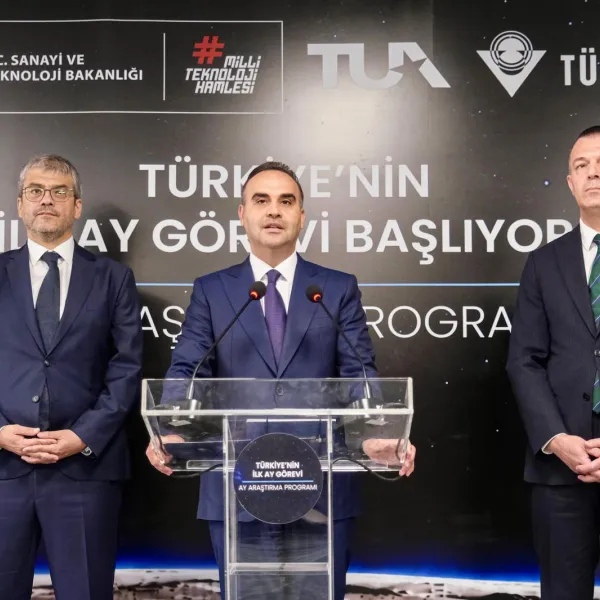

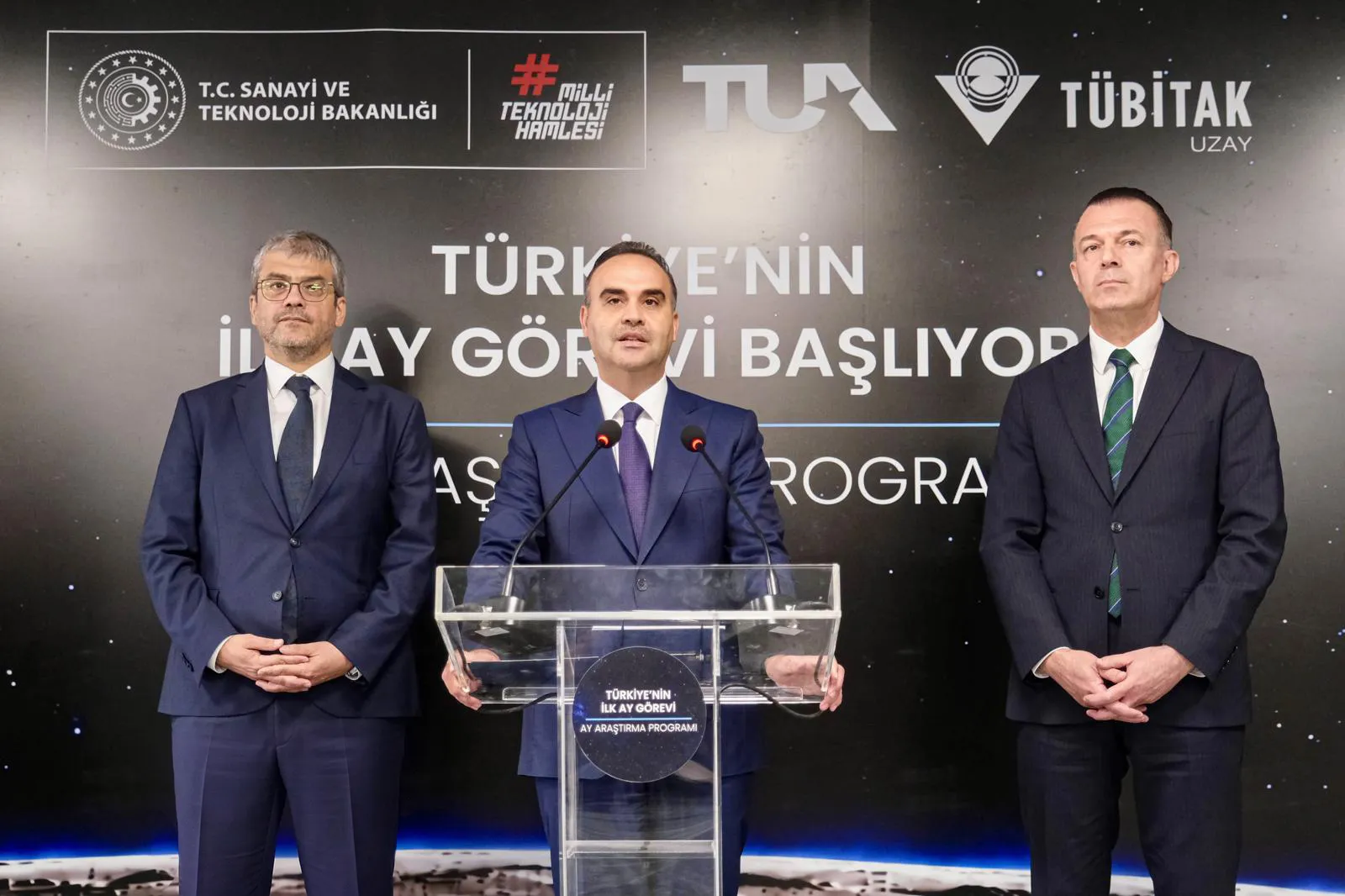
The production, assembly, and integration activities of the Lunar Spacecraft, developed by TÜBİTAK UZAY as part of the Lunar Research Program under the National Space Program, have been successfully completed. The spacecraft was unveiled to the public at a press conference attended by Minister of Industry and Technology Mehmet Fatih Kacır. It was subsequently dispatched from the TÜBİTAK UZAY OPMER facilities to undergo system-level environmental testing, one of the most critical stages prior to launch.
Minister Kacır stated that a historic milestone had been reached in Türkiye’s first deep-space mission and said, “We are sending our spacecraft, whose production, assembly, and integration activities have been completed to enable it to reach the Moon, to the Space Systems Integration and Test Center (USET) within TUSAŞ for system-level environmental testing. May this important step in our journey toward Türkiye’s first deep-space mission bring prosperity to our country and our nation.”
“We Aim to Become the Ninth Country to Carry Out a Lunar Mission”
Highlighting the strategic importance of space in achieving technological superiority and strategic independence, Minister Kacır made the following remarks:
“Only eight countries have carried out lunar missions to date. With our Lunar Research Program, which we have developed through our own engineering capabilities, we aim to become the ninth country to carry out a lunar mission. We expect our Lunar Spacecraft, which we plan to launch in the early months of 2027, to reach its polar mission orbit approximately 100 kilometers above the lunar surface following a journey of around two months. We plan to conduct operations there for at least three months and, depending on mission performance, we will be able to extend this period to up to 1.5 years. Once the scientific activities have been completed, we will reach the lunar surface by performing controlled maneuvers using our domestically developed hybrid propulsion system.”
Minister Kacır also noted that work has begun on the TÜRKSAT 7A satellite, which will provide high-speed data transmission and disaster communications, and stated that Türkiye’s space-based Earth observation capabilities will be significantly enhanced through the next-generation İMECE-2 and İMECE-3 Earth observation satellite constellation.
Critical Tests Ahead of the Lunar Journey
The approximately 3.5-tonne spacecraft, whose integration activities have been completed at the OPMER facilities, will undergo a series of critical tests, including acoustic load and vibration tests simulating the conditions it will be exposed to during launch, as well as thermal vacuum tests simulating the space environment and electromagnetic compatibility tests.
Following the successful completion of these tests, the spacecraft will be transferred to TÜBİTAK UZAY’s new cleanroom and integration center at the METU campus for final pre-launch inspections and preparations. Once the final preparations are completed, the spacecraft will be transported via Ankara Esenboğa Airport to the Kennedy Space Center in the United States, where the launch operation will take place.
İMECE and TÜRKSAT 6A Legacy Extends into Deep Space
The spacecraft consists of two main modules—the platform and propulsion modules—and 56 of its 65 mission-critical components were manufactured entirely using domestic capabilities. Flight computers, power regulation units, S- and X-band communication systems, and insulation equipment whose operational performance has been proven through the İMECE and TÜRKSAT 6A projects have been integrated into TstarD-100, a platform specifically developed by TÜBİTAK UZAY for deep-space conditions.
The domestically developed Hybrid Propulsion System, developed in partnership with DeltaV, will perform both orbit-raising and mission-termination burns. The spacecraft has a diameter of 4.1 meters at launch and expands to dimensions of 2.7 by 8.3 meters once its solar panels are deployed.
Contributing to Global Lunar Exploration Through Scientific Payloads
The spacecraft will carry four advanced scientific payloads: a domestically developed Radiation Calorimeter and Radiation Dosimeter, as well as a Lunar Neutral Particle Telescope developed in partnership with the Swedish Institute of Space Physics and a Narrow-Angle Lunar Radiometer developed in collaboration with Shenzhen University in China.
The spacecraft will investigate the interaction of solar winds with the lunar surface, the Moon’s local magnetic fields, and the mechanisms involved in water formation on the Moon. By making the data it collects available to national and international scientists, the mission will contribute reference models to the global scientific literature that can support future crewed lunar missions.